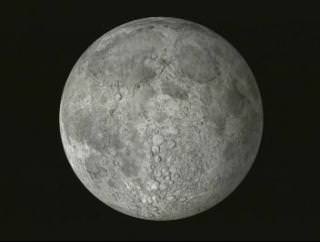
Moon Rotation
Astronomers say that the Moon is tidally locked to the Earth. At some point in the past, it did have a different rotation rate from its orbital period. But slight differences in the shape of the Moon caused the Moon to experience different amounts of gravity depending on its position. These differences acted as a brake, slowing the Moon rotation speed down until it matched its orbital period. There are other tidally locked moons in the Solar System. Pluto and its moon Charon are tidally locked to each other, so they always present the same face to one another.
We’ve written many articles about rotation for Universe Today. Here’s an article about the rotation of the Earth, and here’s an article about the rotation of Saturn.
If you’d like more info on the Moon, check out NASA’s Solar System Exploration G
Reference:
Does the Moon Rotate?
The 'dark' side of the moon
The moon orbits the Earth once every 27.322 days. It also takes approximately 27 days for the moon to rotate once on its axis. As a result, the moon does not seem to be spinning but appears to observers from Earth to be keeping almost perfectly still. Scientists call this synchronous rotation.The side of the moon that perpetually faces Earth is known as the near side. The opposite or "back" side is the far side. Sometimes the far side is called the dark side of the moon, but this is inaccurate. When the moon is between the Earth and the sun, during the new moon phase, the back side of the moon is bathed in daylight.
The orbit and the rotation aren't perfectly matched, however. The moon travels around the Earth in an elliptical orbit, a slightly stretched-out circle. When the moon is closest to Earth, its rotation is slower than its journey through space, allowing observers to see an additional 8 degrees on the eastern side. When the moon is farthest, the rotation is faster, so an additional 8 degrees are visible on the western side. [The Moon: 10 Surprising Lunar Facts]
Although you can't see the back side of the moon from Earth, NASA and other space agencies have glimpsed it with satellites.
"It is surprising how much brighter Earth is than the moon," Adam Szabo, project scientist for NASA's Deep Space Climate Observatory satellite at Goddard Space Flight Center in Greenbelt, Maryland, said in a statement after the satellite captured the moon crossing Earth's face. "Our planet is a truly brilliant object in dark space compared to the lunar surface."
A changing orbit
The rotational period of the moon wasn't always equal to its orbit around the planet. Just like the gravity of the moon affects ocean tides on the Earth, gravity from Earth affects the moon. But because the moon lacks an ocean, Earth pulls on its crust, creating a tidal bulge at the line that points toward Earth. [Infographic: Inside Earth's Moon]Gravity from Earth pulls on the closest tidal bulge, trying to keep it aligned. This creates tidal friction that slows the moon's rotation. Over time, the rotation was slowed enough that the moon's orbit and rotation matched, and the same face became tidally locked, forever pointed toward Earth.
The moon is not the only satellite to suffer friction with its parent planet. Many other large moons in the solar system are tidally locked with their partner. Of the larger moons, only Saturn's moon Hyperion, which tumbles chaotically and interacts with other moons, is not tidally synchronized.
The lunar rotation determined whether the infamous Man in the Moon, a face-like pattern of dark maria on the Earth-facing side, wound up pointing toward our planet. Gravity created an Earth-side bulge in the moon, slowing down its rotation in the past to create the synchronous rotation and keeping the longer lunar axis toward our world. Recent research suggested that the side of the moon facing Earth was determined by how quickly the lunar rotation slowed. Because the moon lost speed slowly, there was about a two-to-one chance that the Man in the Moon would wind up facing Earth rather than keeping a space-bound view.
"The real coincidence is not that the man faces Earth," Oded Aharonson, a planetary science researcher at the California Institute of Technology who studied why the Man in the Moon stares down at Earth, said in a statement. Instead, the real coincidence is that the moon's slowdown was just enough to load the coin.
The situation is not limited to large planets. The dwarf planet Pluto is tidally locked to its moon Charon, which is almost as large as the former planet.
Earth (and other planets) do not escape completely unscathed. Just as the Earth exerts friction on the spin of the moon, the moon also exerts friction on the rotation of the Earth. As such, the length of day increases a few milliseconds every century.
"The moon and Earth loomed large in each others skies when they formed," then-graduate student Arpita Roy said in a statement.
"At the time of the dinosaurs, Earth completed one rotation in about 23 hours," Daniel MacMillan, of NASA's Goddard Space Flight Center in Greenbelt, Maryland, said in a statement. "In the year 1820, a rotation took exactly 24 hours, or 86,400 standard seconds. Since 1820, the mean solar day has increased by about 2.5 milliseconds."
On June 30, 2012, an extra second was added to all of the clocks on Earth because of this phenomenon.
uide on the Moon, and here’s a link to NASA’s Lunar and Planetary Science page.
astrogirlwest
YouTube - Feb 5, 2009


No comments:
Post a Comment