HISTORY OF TIME AND CALENDER.
By;WILSON .U.LUCKY.A.
Writer for WILSON LUCKY BLOG.
1. Introduction
A calendar is a system of organizing units of time for the purpose of
reckoning time over extended periods.
By convention, the day is the smallest calendrical unit of time; the
measurement of fractions of a day is classified as timekeeping.
The generality of this definition is due to the diversity of methods
that have been used in creating calendars.
Although some calendars replicate astronomical cycles according to
fixed rules, others are based on abstract, perpetually repeating cycles
of no astronomical significance.
Some calendars are regulated by astronomical observations, some
carefully and redundantly enumerate every unit, and some contain
ambiguities and discontinuities.
Some calendars are codified in written laws; others are transmitted by
oral tradition.
The common theme of calendar making is the desire to organize units of
time to satisfy the needs and preoccupations of society.
In addition to serving practical purposes, the process of organization
provides a sense, however illusory, of understanding and controlling
time itself.
Thus calendars serve as a link between mankind and the cosmos.
It is little wonder that calendars have held a sacred status and have
served as a source of social order and cultural identity.
Calendars have provided the basis for planning agricultural, hunting,
and migration cycles, for divination and prognostication, and for
maintaining cycles of religious and civil events.
Whatever their scientific sophistication, calendars must ultimately be
judged as social contracts, not as scientific treatises.
According to a recent estimate (Fraser, 1987), there are about forty
calendars used in the world today.
This chapter is limited to the half-dozen principal calendars in current
use.
Furthermore, the emphasis of the chapter is on function and calculation
rather than on culture.
The fundamental bases of the calendars are given, along with brief
historical summaries.
Although algorithms are given for correlating these systems, close
examination reveals that even the standard calendars are subject to
local variation.
With the exception of the Julian calendar, this chapter does not deal
with extinct systems.
Inclusion of the Julian calendar is justified by its everyday use in
historical studies.
Despite a vast literature on calendars, truly authoritative references,
particularly in English, are difficult to find.
Aveni (1989) surveys a broad variety of calendrical systems, stressing
their cultural contexts rather than their operational details.
Parise (1982) provides useful, though not infallible, tables for date
conversion.
Fotheringham (1935) and the Encyclopedia of Religion and Ethics (1910), in its section on "Calendars," offer basic information on historical calendars.
The sections on "Calendars" and "Chronology" in all editions of the Encyclopedia Britannica provide useful historical surveys.
Ginzel (1906) remains an authoritative, if dated, standard of calendrical scholarship.
References on individual calendars are given in the relevant sections.
1.1 Astronomical Bases of Calendars
The principal astronomical cycles are the day (based on the rotation of
the Earth on its axis), the year (based on the revolution of the Earth
around the Sun), and the month (based on the revolution of the Moon
around the Earth).
The complexity of calendars arises because these cycles of revolution do
not comprise an integral number of days, and because astronomical
cycles are neither constant nor perfectly commensurable with each other.
The tropical year is defined as the mean interval between
vernal equinoxes; it corresponds to the cycle of the seasons.
The following expression, based on the orbital elements of Laskar
(1986), is used for calculating the length of the tropical year:
365.2421896698 - 0.00000615359 T - 7.29E-10 T^2 + 2.64E-10 T^3 [days]
where T = (JD - 2451545.0)/36525 and JD is the Julian day number.
However, the interval from a particular vernal equinox to the next may vary from this mean by several minutes.
The synodic month, the mean interval between conjunctions of the Moon and Sun, corresponds to the cycle of lunar phases.
The following expression for the synodic month is based on the lunar theory of Chapront-Touze' and Chapront (1988):
29.5305888531 + 0.00000021621 T - 3.64E-10 T^2 [days].
Again T = (JD - 2451545.0)/36525 and JD is the Julian day number.
Any particular phase cycle may vary from the mean by up to seven hours.
In the preceding formulas, T is measured in Julian centuries of
Terrestrial Dynamical Time (TDT), which is independent of the variable
rotation of the Earth.
Thus, the lengths of the tropical year and synodic month are here
defined in days of 86400 seconds of International Atomic Time (TAI).
From these formulas we see that the cycles change slowly with time.
Furthermore, the formulas should not be considered to be absolute facts; they are the best approximations possible today.
Therefore, a calendar year of an integral number of days cannot be perfectly synchronized to the tropical year.
Approximate synchronization of calendar months with the lunar phases requires a complex sequence of months of 29 and 30 days.
For convenience it is common to speak of a lunar year of twelve synodic months, or 354.36707 days.
Three distinct types of calendars have resulted from this situation.
A solar calendar, of which the Gregorian calendar in its civil usage is an example, is designed to maintain synchrony with the tropical year.
To do so, days are intercalated (forming leap years) to increase the average length of the calendar year.
A lunar calendar, such as the Islamic calendar, follows the lunar phase cycle without regard for the tropical year.
Thus the months of the Islamic calendar systematically shift with respect to the months of the Gregorian calendar.
The third type of calendar, the lunisolar calendar, has a
sequence of months based on the lunar phase cycle; but every few years a
whole month is intercalated to bring the calendar back in phase with
the tropical year.
The Hebrew and Chinese calendars are examples of this type of calendar.
1.2 Nonastronomical Bases of Calendars: the Week
[omitted]
1.3 Calendar Reform and Accuracy
In most societies a calendar reform is an extraordinary event.
Adoption of a calendar depends on the forcefulness with which it is introduced and on the willingness of society to accept it.
For example, the acceptance of the Gregorian calendar as a worldwide standard spanned more than three centuries.
The legal code of the United States does not specify an official
national calendar.
Use of the Gregorian calendar in the United States stems from an Act of
Parliament of the United Kingdom in 1751, which specified use of the
Gregorian calendar in England and its colonies.
However, its adoption in the United Kingdom and other countries was
fraught with confusion, controversy, and even violence (Bates, 1952;
Gingerich, 1983; Hoskin, 1983).
It also had a deeper cultural impact through the disruption of
traditional festivals and calendrical practices (MacNeill, 1982).
Because calendars are created to serve societal needs, the question of a
calendar's accuracy is usually misleading or misguided.
A calendar that is based on a fixed set of rules is accurate if the
rules are consistently applied.
For calendars that attempt to replicate astronomical cycles, one can ask
how accurately the cycles are replicated.
However, astronomical cycles are not absolutely constant, and they are
not known exactly.
In the long term, only a purely observational calendar maintains
synchrony with astronomical phenomena.
However, an observational calendar exhibits short-term uncertainty,
because the natural phenomena are complex and the observations are
subject to error.
1.4 Historical Eras and Chronology
The calendars treated in this chapter, except for the Chinese calendar,
have counts of years from initial epochs.
In the case of the Chinese calendar and some calendars not included
here, years are counted in cycles, with no particular cycle specified
as the first cycle.
Some cultures eschew year counts altogether but name each year after an
event that characterized the year.
However, a count of years from an initial epoch is the most successful
way of maintaining a consistent chronology.
Whether this epoch is associated with an historical or legendary event,
it must be tied to a sequence of recorded historical events.
This is illustrated by the adoption of the birth of Christ as the
initial epoch of the Christian calendar.
This epoch was established by the sixth-century scholar Dionysius
Exiguus, who was compiling a table of dates of Easter.
An existing table covered the nineteen-year period denoted 228-247,
where years were counted from the beginning of the reign of the Roman
emperor Diocletian.
Dionysius continued the table for a nineteen-year period, which he
designated Anni Domini Nostri Jesu Christi 532-550.
Thus, Dionysius' Anno Domini 532 is equivalent to Anno Diocletian 248.
In this way a correspondence was established between the new Christian
Era and an existing system associated with historical records.
What Dionysius did not do is establish an accurate date for the birth of
Christ.
Although scholars generally believe that Christ was born some years
before A.D. 1, the historical evidence is too sketchy to allow a
definitive dating.
Given an initial epoch, one must consider how to record preceding dates.
Bede, the eighth-century English historian, began the practice of
counting years backward from A.D. 1 (see Colgrave and Mynors, 1969).
In this system, the year A.D. 1 is preceded by the year 1 B.C., without
an intervening year 0.
Because of the numerical discontinuity, this "historical" system is
cumbersome for comparing ancient and modern dates.
Today, astronomers use +1 to designate A.D. 1. Then +1 is naturally
preceded by year 0, which is preceded by year -1.
Since the use of negative numbers developed slowly in Europe, this
"astronomical" system of dating was delayed until the eighteenth
century, when it was introduced by the astronomer Jacques Cassini
(Cassini, 1740).
Even as use of Dionysius' Christian Era became common in ecclesiastical
writings of the Middle Ages, traditional dating from regnal years
continued in civil use.
In the sixteenth century, Joseph Justus Scaliger tried to resolve the
patchwork of historical eras by placing everything on a single system
(Scaliger, 1583).
Instead of introducing negative year counts, he sought an initial epoch
in advance of any historical record.
His numerological approach utilized three calendrical cycles: the
28-year solar cycle, the nineteen-year cycle of Golden Numbers, and the
fifteen-year indiction cycle.
The solar cycle is the period after which weekdays and calendar dates
repeat in the Julian calendar.
The cycle of Golden Numbers is the period after which moon phases repeat
(approximately) on the same calendar dates.
The indiction cycle was a Roman tax cycle.
Scaliger could therefore characterize a year by the combination of
numbers (S,G,I), where S runs from 1 through 28, G from 1 through 19,
and I from 1 through 15.
Scaliger noted that a given combination would recur after 7980 (=
28*19*15) years.
He called this a Julian Period, because it was based on the Julian
calendar year.
For his initial epoch Scaliger chose the year in which S, G, and I were
all equal to 1.
He knew that the year 1 B.C.
was characterized by the number 9 of the solar cycle, by the Golden
Number 1, and by the number 3 of the indiction cycle, i.e., (9,1,3).
He found that the combination (1,1,1) occurred in 4713 B.C.
or, as astronomers now say, -4712.
This serves as year 1 of Scaliger's Julian Period.
It was later adopted as the initial epoch for the Julian day numbers.
2. The Gregorian Calendar
The Gregorian calendar today serves as an international standard for civil use.
In addition, it regulates the ceremonial cycle of the Roman Catholic and Protestant churches.
In fact, its original purpose was ecclesiastical.
Although a variety of other calendars are in use today, they are restricted to particular religions or cultures.
2.1 Rules for Civil Use
Years are counted from the initial epoch defined by Dionysius Exiguus,
and are divided into two classes: common years and leap years.
A common year is 365 days in length; a leap year is 366 days, with an
intercalary day, designated February 29, preceding March 1.
Leap years are determined according to the following rule:
Every year that is exactly divisible by 4 is a leap year, except for years that are exactly divisible by 100;
these centurial years are leap years only if they are exactly divisible by 400.
As a result the year 2000 is a leap year, whereas 1900 and 2100 are not leap years.
These rules can be applied to times prior to the Gregorian reform to create a proleptic Gregorian calendar.
In this case, year 0 (1 B.C.) is considered to be exactly divisible by 4, 100, and 400; hence it is a leap year.
The Gregorian calendar is thus based on a cycle of 400 years, which
comprises 146097 days.
Since 146097 is evenly divisible by 7, the Gregorian civil calendar
exactly repeats after 400 years.
Dividing 146097 by 400 yields an average length of 365.2425 days per
calendar year, which is a close approximation to the length of the
tropical year.
Comparison with Equation 1.1-1 reveals that the Gregorian calendar
accumulates an error of one day in about 2500 years.
Although various adjustments to the leap-year system have been proposed,
none has been instituted.
Within each year, dates are specified according to the count of days from the beginning of the month.
The order of months and number of days per month were adopted from the Julian calendar.
Table 2.1.1
Months of the Gregorian Calendar
| 1. January | 31 | 7. July | 31 |
| 2. February | 28* | 8. August | 31 |
| 3. March | 31 | 9. September | 30 |
| 4. April | 30 | 10. October | 31 |
| 5. May | 31 | 11. November | 30 |
| 6. June | 30 | 12. December | 31 |
* In a leap year, February has 29 days.
2.2 Ecclesiastical Rules
The ecclesiastical calendars of Christian churches are based on cycles
of movable and immovable feasts.
Christmas is the principal immovable feast, with its date set at
December 25.
Easter is the principal movable feast, and dates of most other movable
feasts are determined with respect to Easter.
However, the movable feasts of the Advent and Epiphany seasons are
Sundays reckoned from Christmas and the Feast of the Epiphany,
respectively.
In the Gregorian calendar, the date of Easter is defined to occur on the
Sunday following the ecclesiastical Full Moon that falls on or next
after March 21.
This should not be confused with the popular notion that Easter is the
first Sunday after the first Full Moon following the vernal equinox.
In the first place, the vernal equinox does not necessarily occur on
March 21.
In addition, the ecclesiastical Full Moon is not the astronomical Full
Moon -- it is based on tables that do not take into account the full
complexity of lunar motion.
As a result, the date of an ecclesiastical Full Moon may differ from
that of the true Full Moon.
However, the Gregorian system of leap years and lunar tables does
prevent progressive departure of the tabulated data from the
astronomical phenomena.
The ecclesiastical Full Moon is defined as the fourteenth day of a
tabular lunation, where day 1 corresponds to the ecclesiastical New
Moon.
The tables are based on the Metonic cycle, in which 235 mean synodic
months occur in 6939.688 days.
Since nineteen Gregorian years is 6939.6075 days, the dates of Moon
phases in a given year will recur on nearly the same dates nineteen
years laters.
To prevent the 0.08 day difference between the cycles from accumulating,
the tables incorporate adjustments to synchronize the system over
longer periods of time.
Additional complications arise because the tabular lunations are of 29
or 30 integral days.
The entire system comprises a period of 5700000 years of 2081882250
days, which is equated to 70499183 lunations.
After this period, the dates of Easter repeat themselves.
The following algorithm for computing the date of Easter is based on the algorithm of Oudin (1940).
It is valid for any Gregorian year, Y.
All variables are integers and the remainders of all divisions are dropped.
The final date is given by M, the month, and D, the day of the month.
C = Y/100,
N = Y - 19*(Y/19),
K = (C - 17)/25,
I = C - C/4 - (C - K)/3 + 19*N + 15,
I = I - 30*(I/30),
I = I - (I/28)*(1 - (I/28)*(29/(I + 1))*((21 - N)/11)),
J = Y + Y/4 + I + 2 - C + C/4,
J = J - 7*(J/7),
L = I - J,
M = 3 + (L + 40)/44,
D = L + 28 - 31*(M/4).
2.3 History of the Gregorian Calendar
The Gregorian calendar resulted from a perceived need to reform the
method of calculating dates of Easter.
Under the Julian calendar the dating of Easter had become standardized,
using March 21 as the date of the equinox and the Metonic cycle as the
basis for calculating lunar phases.
By the thirteenth century it was realized that the true equinox had
regressed from March 21 (its supposed date at the time of the Council of
Nicea, +325) to a date earlier in the month.
As a result, Easter was drifting away from its springtime position and
was losing its relation with the Jewish Passover.
Over the next four centuries, scholars debated the "correct" time for
celebrating Easter and the means of regulating this time calendrically.
The Church made intermittent attempts to solve the Easter question,
without reaching a consensus.
By the sixteenth century the equinox had shifted by ten days, and
astronomical New Moons were occurring four days before ecclesiastical
New Moons.
At the behest of the Council of Trent, Pope Pius V introduced a new
Breviary in 1568 and Missal in 1570, both of which included adjustments
to the lunar tables and the leap-year system.
Pope Gregory XIII, who succeeded Pope Pius in 1572, soon convened a
commission to consider reform of the calendar, since he considered his
predecessor's measures inadequate.
The recommendations of Pope Gregory's calendar commission were
instituted by the papal bull "Inter Gravissimus," signed on 1582
February 24.
Ten days were deleted from the calendar, so that 1582 October 4 was
followed by 1582 October 15, thereby causing the vernal equinox of 1583
and subsequent years to occur about March 21.
And a new table of New Moons and Full Moons was introduced for
determining the date of Easter.
Subject to the logistical problems of communication and governance in
the sixteenth century, the new calendar was promulgated through the
Roman-Catholic world.
Protestant states initially rejected the calendar, but gradually
accepted it over the coming centuries.
The Eastern Orthodox churches rejected the new calendar and continued to
use the Julian calendar with traditional lunar tables for calculating
Easter.
Because the purpose of the Gregorian calendar was to regulate the cycle
of Christian holidays, its acceptance in the non-Christian world was
initially not at issue.
But as international communications developed, the civil rules of the
Gregorian calendar were gradually adopted around the world.
Anyone seriously interested in the Gregorian calendar should study the
collection of papers resulting from a conference sponsored by the
Vatican to commemorate the four-hundredth anniversary of the Gregorian
Reform (Coyne et al., 1983).
3. The Hebrew Calendar
As it exists today, the Hebrew calendar is a lunisolar calendar that is based on calculation rather than observation.
This calendar is the official calendar of Israel and is the liturgical calendar of the Jewish faith.
In principle the beginning of each month is determined by a tabular New Moon (molad)
that is based on an adopted mean value of the lunation cycle.
To ensure that religious festivals occur in appropriate seasons, months
are intercalated according to the Metonic cycle, in which 235 lunations
occur in nineteen years.
By tradition, days of the week are designated by number, with only the seventh day, Sabbath, having a specific name.
Days are reckoned from sunset to sunset, so that day 1 begins at sunset on Saturday and ends at sunset on Sunday.
The Sabbath begins at sunset on Friday and ends at sunset on Saturday.
3.1 Rules
Years are counted from the Era of Creation, or Era Mundi, which
corresponds to -3760 October 7 on the Julian proleptic calendar.
Each year consists of twelve or thirteen months, with months consisting
of 29 or 30 days.
An intercalary month is introduced in years 3, 6, 8, 11, 14, 17, and 19
in a nineteen-year cycle of 235 lunations.
The initial year of the calendar, A.M. (Anno Mundi) 1, is year 1 of the
nineteen-year cycle.
The calendar for a given year is established by determining the day of
the week of Tishri 1 (first day of Rosh Hashanah or New Year's Day) and
the number of days in the year.
Years are classified according to the number of days in the year (see
Table 3.1.1).
Table 3.1.1
Classification of Years in the Hebrew Calendar
|
| Deficient | Regular | Complete |
| Ordinary year |
| 353 | 354 | 355 |
| Leap year |
| 383 | 384 | 385 |
Table 3.1.2
Months of the Hebrew Calendar
| 1. Tishri | 30 | 7. Nisan | 30 |
| 2. Heshvan | 29* | 8. Iyar | 29 |
| 3. Kislev | 30** | 9. Sivan | 30 |
| 4. Tevet | 29 | 10. Tammuz | 29 |
| 5. Shevat | 30 | 11. Av | 30 |
| 6. Adar | 29*** | 12. Elul | 29 |
* In a complete year, Heshvan has 30 days.
** In a deficient year, Kislev has 29 days.
*** In a leap year Adar I has 30 days; it is followed by Adar II with 29 days.
Table 3.1.3
Terminology of the Hebrew Calendar
| Deficient (haser) month: a month comprising 29 days. |
| Full (male) month: a month comprising 30 days. |
| Ordinary year: a year comprising 12 months, with a total of 353, 354, or 355
days. |
| Leap year: a year comprising 13 months, with a total of 383, 384, or 385 days.
|
| Complete year (shelemah): a year in which the months of
Heshvan and Kislev both contain 30 days. |
| Deficient year (haser): a year in which the months of
Heshvan and Kislev both contain 29 days. |
| Regular year (kesidrah): a year in which
Heshvan has 29 days and Kislev has 30 days. |
| Halakim(singular, helek): "parts" of an hour; there are 1080
halakim per hour. |
| Molad(plural, moladot): "birth" of the Moon, taken to mean the time of conjunction for modern calendric purposes. |
| Dehiyyah(plural, dehiyyot): "postponement"; a rule delaying 1 Tishri until after the molad. |
The months of Heshvan and Kislev vary in length to satisfy requirements for the length of the year (see Table 3.1.1).
In leap years, the 29-day month Adar is designated Adar II, and is preceded by the 30-day intercalary month Adar I.
For calendrical calculations, the day begins at 6 P.M., which is designated 0 hours.
Hours are divided into 1080 halakim; thus one helek is
3 1/3 seconds.
(Terminology is explained in Table 3.1.3.) Calendrical calculations are
referred to the meridian of Jerusalem -- 2 hours 21 minutes east of
Greenwich.
Rules for constructing the Hebrew calendar are given in the sections that follow.
Cohen (1981), Resnikoff (1943), and Spier (1952) provide reliable guides to the rules of calculation.
3.1.1 Determining Tishri 1
The calendar year begins with the first day of Rosh Hashanah (Tishri 1).
This is determined by the day of the Tishri molad and the four rules of postponements (dehiyyot).
The dehiyyot can postpone Tishri 1 until one or two days following the molad.
Tabular new moons (maladot) are reckoned from the Tishri molad of the year A.M. 1, which occurred on day 2 at 5 hours, 204 halakim (i.e., 11:11:20 P.M. on Sunday, -3760 October 6, Julian proleptic calendar).
The adopted value of the mean lunation is 29 days, 12 hours, 793 halakim (29.530594 days).
To avoid rounding and truncation errors, calculation should be done in halakim rather than decimals of a day, since the adopted lunation constant is expressed exactly in halakim.
Table 3.1.1.1
Lunation Constants for Determining Tishri 1
| Lunations |
| Weeks-Days-Hours-Halakim |
| 1 | = | 4-1-12-0793 |
| 12 | = | 50-4-08-0876 |
| 13 | = | 54-5-21-0589 |
| 235 | = | 991-2-16-0595 |
Lunation constants required in calculations are shown in Table 3.1.1.1.
By subtracting off the weeks, these constants give the shift in
weekdays that occurs after each cycle.
The dehiyyot are as follows:
(a) If the Tishri molad falls on day 1, 4, or 6, then Tishri 1 is postponed one day.
(b) If the Tishri molad occurs at or after 18 hours (i.e., noon), then Tishri 1 is postponed one day.
If this causes Tishri 1 to fall on day 1, 4, or 6, then Tishri 1 is postponed an additional day to satisfy dehiyyah
(a).
(c) If the Tishri molad of an ordinary year (i.e., of twelve months) falls on day 3 at or after 9 hours, 204 halakim, then Tishri 1 is postponed two days to day 5, thereby satisfying dehiyyah (a).
(d) If the first molad following a leap year falls on day 2 at or after 15 hours, 589 halakim, then Tishri 1 is postponed one day to day 3.
3.1.2 Reasons for the Dehiyyot
Dehiyyah (a) prevents Hoshana Rabba (Tishri 21) from occurring
on the Sabbath and prevents Yom Kippur (Tishri 10) from occurring on the
day before or after the Sabbath.
Dehiyyah (b) is an artifact of the ancient practice of beginning each month with the sighting of the lunar crescent.
It is assumed that if the molad (i.e., the mean conjunction)
occurs after noon, the lunar crescent cannot be sighted until after 6
P.M., which will then be on the following day.
Dehiyyah (c) prevents an ordinary year from exceeding 355 days.
If the Tishri molad of an ordinary year occurs on Tuesday at or after 3:11:20 A.M., the next Tishri molad will occur at or after noon on Saturday.
According to dehiyyah (b), Tishri 1 of the next year must be postponed to Sunday, which by dehiyyah (a) occasions a further postponement to Monday.
This results in an ordinary year of 356 days.
Postponing Tishri 1 from Tuesday to Thursday produces a year of 354 days.
Dehiyyah (d) prevents a leap year from falling short of 383 days.
If the Tishri molad following a leap year is on Monday, at or after 9:32:43 1/3 A.M., the previous Tishri molad (thirteen months earlier) occurred on Tuesday at or after noon.
Therefore, by dehiyyot (b) and (a), Tishri 1 beginning the leap year was postponed to Thursday.
To prevent a leap year of 382 days, dehiyyah (d) postpones by one day the beginning of the ordinary year.
A thorough discussion of both the functional and religious aspects of the dehiyyot is provided by Cohen (1981).
3.1.3 Determining the Length of the Year
An ordinary year consists of 50 weeks plus 3, 4, or 5 days.
The number of excess days identifies the year as being deficient,
regular, or complete, respectively.
A leap year consists of 54 weeks plus 5, 6, or 7 days, which again are
designated deficient, regular, or complete, respectively.
The length of a year can therefore be determined by comparing the
weekday of Tishri 1 with that of the next Tishri 1.
First consider an ordinary year.
The weekday shift after twelve lunations is 04-08-876.
For example if a Tishri molad of an ordinary year occurs on day 2 at 0 hours 0 halakim (6 P.M. on Monday), the next Tishri molad will occur on day 6 at 8 hours 876 halakim. The first Tishri molad does not require application of the dehiyyot, so Tishri 1 occurs on day 2.
Because of dehiyyah (a), the following Tishri 1 is delayed by one day to day 7, five weekdays after the previous Tishri 1.
Since this characterizes a complete year, the months of Heshvan and Kislev both contain 30 days.
The weekday shift after thirteen lunations is 05-21-589.
If the Tishri molad of a leap year occurred on day 4 at 20 hours 500 halakim, the next Tishri molad will occur on day 3 at 18 hours 9 halakim.
Becuase of dehiyyot (b), Tishri 1 of the leap year is postponed two days to day 6.
Because of dehiyyot (c), Tishri 1 of the following year is postponed two days to day 5.
This six-day difference characterizes a regular year, so that Heshvan has 29 days and Kislev has 30 days.
3.2 History of the Hebrew Calendar
The codified Hebrew calendar as we know it today is generally considered
to date from A.M. 4119 (+359), though the exact date is uncertain.
At that time the patriarch Hillel II, breaking with tradition,
disseminated rules for calculating the calendar.
Prior to that time the calendar was regarded as a secret science of the
religious authorities.
The exact details of Hillel's calendar have not come down to us, but it
is generally considered to include rules for intercalation over
nineteen-year cycles.
Up to the tenth century A.D., however, there was disagreement about the
proper years for intercalation and the initial epoch for reckoning
years.
Information on calendrical practices prior to Hillel is fragmentary and often contradictory.
The earliest evidence indicates a calendar based on observations of Moon phases.
Since the Bible mentions seasonal festivals, there must have been intercalation.
There was likely an evolution of conflicting calendrical practices.
The Babylonian exile, in the first half of the sixth century B.C., greatly influenced the Hebrew calendar.
This is visible today in the names of the months.
The Babylonian influence may also have led to the practice of intercalating leap months.
During the period of the Sanhedrin, a committee of the Sanhedrin met to
evaluate reports of sightings of the lunar crescent.
If sightings were not possible, the new month was begun 30 days after
the beginning of the previous month.
Decisions on intercalation were influenced, if not determined entirely,
by the state of vegetation and animal life.
Although eight-year, nineteen-year, and longer- period intercalation
cycles may have been instituted at various times prior to Hillel II,
there is little evidence that they were employed consistently over long
time spans.
4. The Islamic Calendar
The Islamic calendar is a purely lunar calendar in which months correspond to the lunar phase cycle.
As a result, the cycle of twelve lunar months regresses through the seasons over a period of about 33 years.
For religious purposes, Muslims begin the months with the first visibility of the lunar crescent after conjunction.
For civil purposes a tabulated calendar that approximates the lunar phase cycle is often used.
The seven-day week is observed with each day beginning at sunset.
Weekdays are specified by number, with day 1 beginning at sunset on Saturday and ending at sunset on Sunday.
Day 5, which is called Jum'a, is the day for congregational prayers.
Unlike the Sabbath days of the Christians and Jews, however, Jum'a is not a day of rest.
Jum'a begins at sunset on Thursday and ends at sunset on Friday.
4.1 Rules
Years of twelve lunar months are reckoned from the Era of the Hijra,
commemorating the migration of the Prophet and his followers from Mecca
to Medina.
This epoch, 1 A.H. (Anno Higerae) Muharram 1, is generally taken by
astronomers (Neugebauer, 1975) to be Thursday, +622 July 15 (Julian
calendar).
This is called the astronomical Hijra epoch.
Chronological tables (e.g., Mayr and Spuler, 1961; Freeman-Grenville,
1963) generally use Friday, July 16, which is designated the civil
epoch.
In both cases the Islamic day begins at sunset of the previous day.
For religious purposes, each month begins in principle with the first
sighting of the lunar crescent after the New Moon.
This is particularly important for establishing the beginning and end of
Ramadan.
Because of uncertainties due to weather, however, a new month may be
declared thirty days after the beginning of the preceding month.
Although various predictive procedures have been used for determining
first visibility, they have always had an equivocal status.
In practice, there is disagreement among countries, religious leaders,
and scientists about whether to rely on observations, which are subject
to error, or to use calculations, which may be based on poor models.
Chronologists employ a thirty-year cyclic calendar in studying Islamic
history.
In this tabular calendar, there are eleven leap years in the thirty-year
cycle.
Odd-numbered months have thirty days and even-numbered months have
twenty-nine days, with a thirtieth day added to the twelfth month, Dhu
al-Hijjah (see Table 4.1.1).
Years 2, 5, 7, 10, 13, 16, 18, 21, 24, 26, and 29 of the cycle are
designated leap years.
This type of calendar is also used as a civil calendar in some Muslim
countries, though other years are sometimes used as leap years.
The mean length of the month of the thirty-year tabular calendar is
about 2.9 seconds less than the synodic period of the Moon.
Table 4.1.1
Months of Tabular Islamic Calendar
| 1. Muharram** | 30 | 7. Rajab** | 30 |
| 2. Safar | 29 | 8. Sha'ban | 29 |
| 3. Rabi'a I | 30 | 9. Ramadan*** | 30 |
| 4. Rabi'a II | 29 | 10. Shawwal | 29 |
| 5. Jumada I | 30 | 11. Dhu al-Q'adah** | 30 |
| 6. Jumada II | 29 | 12. Dhu al-Hijjah** | 29* |
* In a leap year, Dhu al-Hijjah has 30 days.
** Holy months.
*** Month of fasting.
4.1.1 Visibility of the Crescent Moon
[omitted]
4.2 History of the Islamic Calendar
The form of the Islamic calendar, as a lunar calendar without
intercalation, was laid down by the Prophet in the Qur'an (Sura IX,
verse 36-37) and in his sermon at the Farewell Pilgrimage.
This was a departure from the lunisolar calendar commonly used in the
Arab world, in which months were based on first sightings of the lunar
crescent, but an intercalary month was added as deemed necessary.
Caliph 'Umar I is credited with establishing the Hijra Era in A.H. 17.
It is not known how the initial date was determined.
However, calculations show that the astronomical New Moon (i.e.,
conjunction) occurred on +622 July 14 at 0444 UT (assuming delta-T = 1.0
hour), so that sighting of the crescent most likely occurred on the
evening of July 16.
5. The Indian Calendar
As a result of a calendar reform in A.D. 1957, the National Calendar of
India is a formalized lunisolar calendar in which leap years coincide
with those of the Gregorian calendar (Calendar Reform Committee, 1957).
However, the initial epoch is the Saka Era, a traditional epoch of
Indian chronology.
Months are named after the traditional Indian months and are offset from
the beginning of Gregorian months (see Table 5.1.1).
In addition to establishing a civil calendar, the Calendar Reform
Committee set guidelines for religious calendars, which require
calculations of the motions of the Sun and Moon.
Tabulations of the religious holidays are prepared by the India
Meteorological Department and published annually in The Indian Astronomical Ephemeris.
Despite the attempt to establish a unified calendar for all of India,
many local variations exist.
The Gregorian calendar continues in use for administrative purposes, and
holidays are still determined according to regional, religious, and
ethnic traditions (Chatterjee, 1987).
5.1 Rules for Civil Use
Years are counted from the Saka Era; 1 Saka is considered to begin with
the vernal equinox of A.D. 79. The reformed Indian calendar began with
Saka Era 1879, Caitra 1, which corresponds to A.D. 1957 March 22.
Normal years have 365 days; leap years have 366.
In a leap year, an intercalary day is added to the end of Caitra.
To determine leap years, first add 78 to the Saka year.
If this sum is evenly divisible by 4, the year is a leap year, unless
the sum is a multiple of 100.
In the latter case, the year is not a leap year unless the sum is also a
multiple of 400.
Table 5.1.1 gives the sequence of months and their correlation with the
months of the Gregorian calendar.
Table 5.1.1
Months of the Indian Civil Calendar
| Days | Correlation of Indian/Gregorian |
|
| 1. Caitra | 30* | Caitra 1 | March 22* |
| 2. Vaisakha | 31 | Vaisakha 1 | April 21 |
| 3. Jyaistha | 31 | Jyaistha 1 | May 22 |
| 4. Asadha | 31 | Asadha 1 | June 22 |
| 5. Sravana | 31 | Sravana 1 | July 23 |
| 6. Bhadra | 31 | Bhadra 1 | August 23 |
| 7. Asvina | 30 | Asvina 1 | September 23 |
| 8. Kartika | 30 | Kartika 1 | October 23 |
| 9. Agrahayana | 30 | Agrahayana 1 | November 22 |
| 10. Pausa | 30 | Pausa 1 | December 22 |
| 11. Magha | 30 | Magha 1 | January 21 |
| 12. Phalguna | 30 | Phalguna 1 | February 20 |
* In a leap year, Caitra has 31 days and Caitra 1 coincides with March 21.
5.2 Principles of the Religious Calendar
Religious holidays are determined by a lunisolar calendar that is based
on calculations of the actual postions of the Sun and Moon.
Most holidays occur on specified lunar dates (tithis), as is explained later; a few occur on specified solar dates.
The calendrical methods presented here are those recommended by the Calendar Reform Committee (1957).
They serve as the basis for the calendar published in The Indian Astronomical Ephemeris.
However, many local calendar makers continue to use traditional
astronomical concepts and formulas, some of which date back 1500 years.
The Calendar Reform Committee attempted to reconcile traditional
calendrical practices with modern astronomical concepts.
According to their proposals, precession is accounted for and
calculations of solar and lunar position are based on accurate modern
methods.
All astronomical calculations are performed with respect to a Central
Station at longitude 82o30' East, latitude 23o11' North.
For religious purposes solar days are reckoned from sunrise to sunrise.
A solar month is defined as the interval required for the Sun's apparent
longitude to increase by 30o, corresponding to the passage of the Sun
through a zodiacal sign (rasi).
The initial month of the year, Vaisakha, begins when the true longitude of the Sun is 23o 15' (see Table 5.2.1).
Because the Earth's orbit is elliptical, the lengths of the months vary from 29.2 to 31.2 days.
The short months all occur in the second half of the year around the time of the Earth's perihelion passage.
Table 5.2.1
Solar Months of the Indian Religious Calendar
| Sun's Longitude | Approx. Duration | Approx. Greg. Date |
| deg min | d |
|
| 1. Vaisakha | 23 15 | 30.9 | Apr. 13 |
| 2. Jyestha | 53 15 | 31.3 | May 14 |
| 3. Asadha | 83 15 | 31.5 | June 14 |
| 4. Sravana | 113 15 | 31.4 | July 16 |
| 5. Bhadrapada | 143 15 | 31.0 | Aug. 16 |
| 6. Asvina | 173 15 | 30.5 | Sept. 16 |
| 7. Kartika | 203 15 | 30.0 | Oct. 17 |
| 8. Margasirsa | 233 15 | 29.6 | Nov. 16 |
| 9. Pausa | 263 15 | 29.4 | Dec. 15 |
| 10. Magha | 293 15 | 29.5 | Jan. 14 |
| 11. Phalgura | 323 15 | 29.9 | Feb. 12 |
| 12. Caitra | 353 15 | 30.3 | Mar. 14 |
Lunar months are measured from one New Moon to the next (although some groups reckon from the Full Moon).
Each lunar month is given the name of the solar month in which the lunar month begins.
Because most lunations are shorter than a solar month, there is occasionally a solar month in which two New Moons occur.
In this case, both lunar months bear the same name, but the first month is described with the prefix adhika, or intercalary.
Such a year has thirteen lunar months.
Adhika months occur every two or three years following patterns described by the Metonic cycle or more complex lunar phase cycles.
More rarely, a year will occur in which a short solar month will pass without having a New Moon.
In that case, the name of the solar month does not occur in the calendar for that year.
Such a decayed (ksaya) month can occur only in the months near
the Earth's perihelion passage.
In compensation, a month in the first half of the year will have had
two New Moons, so the year will still have twelve lunar months.
Ksaya months are separated by as few as nineteen years and as many as 141 years.
Lunations are divided into 30 tithis, or lunar days.
Each tithi is defined by the time required for the longitude of the Moon to increase by 12o over the longitude of the Sun.
Thus the length of a tithi may vary from about 20 hours to nearly 27 hours.
During the waxing phases, tithis are counted from 1 to 15 with the designation Sukla.
Tithis for the waning phases are designated Krsna and are again counted from 1 to 15.
Each day is assigned the number of the tithi in effect at sunrise.
Occasionally a short tithi will begin after sunrise and be completed before the next sunrise.
Similarly a long tithi may span two sunrises.
In the former case, a number is omitted from the day count.
In the latter, a day number is carried over to a second day.
5.3 History of the Indian Calendar
The history of calendars in India is a remarkably complex subject owing
to the continuity of Indian civilization and to the diversity of
cultural influences.
In the mid-1950s, when the Calendar Reform Committee made its survey,
there were about 30 calendars in use for setting religious festivals
for Hindus, Buddhists, and Jainists.
Some of these were also used for civil dating.
These calendars were based on common principles, though they had local
characteristics determined by long-established customs and the
astronomical practices of local calendar makers.
In addition, Muslims in India used the Islamic calendar, and the Indian
government used the Gregorian calendar for administrative purposes.
Early allusions to a lunisolar calendar with intercalated months are
found in the hymns from the Rig Veda, dating from the second millennium
B.C.
Literature from 1300 B.C. to A.D. 300, provides information of a more
specific nature.
A five-year lunisolar calendar coordinated solar years with synodic and
sidereal lunar months.
Indian astronomy underwent a general reform in the first few centuries
A.D., as advances in Babylonian and Greek astronomy became known.
New astronomical constants and models for the motion of the Moon and
Sun were adapted to traditional calendric practices.
This was conveyed in astronomical treatises of this period known as Siddhantas, many of which have not survived.
The Surya Siddhanta, which originated in the fourth century but
was updated over the following centuries, influenced Indian calendrics
up to and even after the calendar reform of A.D. 1957.
Pingree (1978) provides a survey of the development of mathematical
astronomy in India.
Although he does not deal explicitly with calendrics, this material is
necessary for a full understanding of the history of India's calendars.
6. The Chinese Calendar
The Chinese calendar is a lunisolar calendar based on calculations of
the positions of the Sun and Moon.
Months of 29 or 30 days begin on days of astronomical New Moons, with an
intercalary month being added every two or three years.
Since the calendar is based on the true positions of the Sun and Moon,
the accuracy of the calendar depends on the accuracy of the astronomical
theories and calculations.
Although the Gregorian calendar is used in the Peoples' Republic of
China for administrative purposes, the traditional Chinese calendar is
used for setting traditional festivals and for timing agricultural
activities in the countryside.
The Chinese calendar is also used by Chinese communities around the
world.
Table 6.1.1
Chinese Sexagenary Cycle of Days and Years
| Celestial Stems | Earthly Branches |
| 1. jia | 1. zi (rat) |
| 2. yi | 2. chou (ox) |
| 3. bing | 3. yin (tiger) |
| 4. ding | 4. mao (hare) |
| 5. wu | 5. chen (dragon) |
| 6. ji | 6. si (snake) |
| 7. geng | 7. wu (horse) |
| 8. xin | 8. wei (sheep) |
| 9. ren | 9. shen (monkey) |
| 10. gui | 10. you (fowl) |
| 11. xu (dog) |
| 12. hai (pig) |
Year Names
| 1. jia-zi | 16. ji-mao | 31. jia-wu | 46. ji-you |
| 2. yi-chou | 17. geng-chen | 32. yi-wei | 47. geng-xu |
| 3. bing-yin | 18. xin-si | 33. bing-shen | 48. xin-hai |
| 4. ding-mao | 19. ren-wu | 34. ding-you | 49. ren-zi |
| 5. wu-chen | 20. gui-wei | 35. wu-xu | 50. gui-chou |
| 6. ji-si | 21. jia-shen | 36. ji-hai | 51. jia-yin |
| 7. geng-wu | 22. yi-you | 37. geng-zi | 52. yi-mao |
| 8. xin-wei | 23. bing-xu | 38. xin-chou | 53. bing-chen |
| 9. ren-shen | 24. ding-hai | 39. ren-yin | 54. ding-si |
| 10. gui-you | 25. wu-zi | 40. gui-mao | 55. wu-wu |
| 11. jia-xu | 26. ji-chou | 41. jia-chen | 56. ji-wei |
| 12. yi-hai | 27. geng-yin | 42. yi-si | 57. geng-shen |
| 13. bing-zi | 28. xin-mao | 43. bing-wu | 58. xin-you |
| 14. ding-chou | 29. ren-chen | 44. ding-wei | 59. ren-xu |
| 15. wu-yin | 30. gui-si | 45. wu-shen | 60. gui-hai |
6.1 Rules
There is no specific initial epoch for counting years.
In historical records, dates were specified by counts of days and years
in sexagenary cycles and by counts of years from a succession of eras
established by reigning monarchs.
The sixty-year cycle consists of a set of year names that are
created by pairing a name from a list of ten Celestial Stems with a name
from a list of twelve Terrestrial Branches, following the order
specified in Table 6.1.1.
The Celestial Stems are specified by Chinese characters that have no
English translation; the Terrestrial Branches are named after twelve
animals.
After six repetitions of the set of stems and five repetitions of the
branches, a complete cycle of pairs is completed and a new cycle begins.
The initial year (jia-zi) of the current cycle began on 1984 February 2.
Days are measured from midnight to midnight.
The first day of a calendar month is the day on which the astronomical
New Moon (i.e., conjunction) is calculated to occur.
Since the average interval between successive New Moons is approximately
29.53 days, months are 29 or 30 days long.
Months are specified by number from 1 to 12.
When an intercalary month is added, it bears the number of the previous
month, but is designated as intercalary.
An ordinary year of twelve months is 353, 354, or 355 days in length; a
leap year of thirteen months is 383, 384, or 385 days long.
The conditions for adding an intercalary month are determined by the
occurrence of the New Moon with respect to divisions of the tropical
year.
The tropical year is divided into 24 solar terms, in 15o segments of
solar longitude.
These divisions are paired into twelve Sectional Terms (Jieqi) and twelve Principal Terms (Zhongqi), as shown in Table 6.1.2.
These terms are numbered and assigned names that are seasonal or meteorological in nature.
For convenience here, the Sectional and Principal Terms are denoted by S and P, respectively, followed by the number.
Because of the ellipticity of the Earth's
orbit, the interval between solar terms varies with the seasons.
Reference works give a variety of rules for establishing New Year's Day
and for intercalation in the lunisolar calendar.
Since the calendar was originally based on the assumption that the Sun's
motion was uniform through the seasons, the published rules are
frequently inadequate to handle special cases.
The following rules (Liu and Stephenson, in press) are currently used as
the basis for calendars prepared by the Purple Mountain Observatory
(1984):
(1) The first day of the month is the day on which the New Moon occurs.
(2) An ordinary year has twelve lunar months; an intercalary year has thirteen lunar months.
(3) The Winter Solstice (term P-11) always falls in month 11.
(4) In an intercalary year, a month in which there is no Principal Term
is the intercalary month.
It is assigned the number of the preceding month, with the further
designation of intercalary.
If two months of an intercalary year contain no Principal Term, only the
first such month after the Winter Solstice is considered intercalary.
(5) Calculations are based on the meridian 120o East.
The number of the month usually corresponds to the number of the
Principal Term occurring during the month.
In rare instances, however, there are months that have two Principal
Terms, with the result that a nonintercalary month will have no
Principal Term.
As a result the numbers of the months will temporarily fail to
correspond to the numbers of the Principal Terms.
These cases can be resolved by strictly applying rules 2 and 3.
Table 6.1.2
Chinese Solar Terms
| Term* |
| Name | Sun's Longitude | Approx. Greg. Date | Duration |
| S-1 | Lichun | Beginning of Spring | 315 | Feb. 4 |
|
| P-1 | Yushui | Rain Water | 330 | Feb. 19 | 29.8 |
| S-2 | Jingzhe | Waking of Insects | 345 | Mar. 6 |
|
| P-2 | Chunfen | Spring Equinox | 0 | Mar. 21 | 30.2 |
| S-3 | Qingming | Pure Brightness | 15 | Apr. 5 |
|
| P-3 | Guyu | Grain Rain | 30 | Apr. 20 | 30.7 |
| S-4 | Lixia | Beginning of Summer | 45 | May 6 |
|
| P-4 | Xiaoman | Grain Full | 60 | May 21 | 31.2 |
| S-5 | Mangzhong | Grain in Ear | 75 | June 6 |
|
| P-5 | Xiazhi | Summer Solstice | 90 | June 22 | 31.4 |
| S-6 | Xiaoshu | Slight Heat | 105 | July 7 |
|
| P-6 | Dashu | Great Heat | 120 | July 23 | 31.4 |
| S-7 | Liqiu | Beginning of Autumn | 135 | Aug. 8 |
|
| P-7 | Chushu | Limit of Heat | 150 | Aug. 23 | 31.1 |
| S-8 | Bailu | White Dew | 165 | Sept. 8 |
|
| P-8 | Qiufen | Autumnal Equinox | 180 | Sept. 23 | 30.7 |
| S-9 | Hanlu | Cold Dew | 195 | Oct. 8 |
|
| P-9 | Shuangjiang | Descent of Frost | 210 | Oct. 24 | 30.1 |
| S-10 | Lidong | Beginning of Winter | 225 | Nov. 8 |
|
| P-10 | Xiaoxue | Slight Snow | 240 | Nov. 22 | 29.7 |
| S-11 | Daxue | Great Snow | 255 | Dec. 7 |
|
| P-11 | Dongzhi | Winter Solstice | 270 | Dec. 22 | 29.5 |
| S-12 | Xiaohan | Slight Cold | 285 | Jan. 6 |
|
| P-12 | Dahan | Great Cold | 300 | Jan. 20 | 29.5 |
* Terms are classified as Sectional (Jieqi) or Principal
(Zhongqi), followed by the number of the term.
In general, the first step in calculating the Chinese calendar is to
check for the existence of an intercalary year.
This can be done by determining the dates of Winter Solstice and month
11 before and after the period of interest, and then by counting the
intervening New Moons.
Published calendrical tables are often in disagreement about the Chinese
calendar.
Some of the tables are based on mean, or at least simplified, motions of
the Sun and Moon.
Some are calculated for other meridians than 120o East.
Some incorporate a rule that the eleventh, twelfth, and first months are
never followed by an intercalary month.
This is sometimes not stated as a rule, but as a consequence of the
rapid change in the Sun's longitude when the Earth is near perihelion.
However, this statement is incorrect when the motions of the Sun and
Moon are accurately calculated.
6.2 History of the Chinese Calendar
In China the calendar was a sacred document, spopnsored and promulgated
by the reigning monarch.
For more than two millennia, a Bureau of Astronomy made astronomical
observations, calculated astronomical events such as eclipses, prepared
astrological predictions, and maintained the calendar (Needham, 1959).
After all, a successful calendar not only served practical needs, but
also confirmed the consonance between Heaven and the imperial court.
Analysis of surviving astronomical records inscribed on oracle bones
reveals a Chinese lunisolar calendar, with intercalation of lunar
months, dating back to the Shang dynasty of the fourteenth century B.C.
Various intercalation schemes were developed for the early calendars,
including the nineteen-year and 76-year lunar phase cycles that came to
be known in the West as the Metonic cycle and Callipic cycle.
From the earliest records, the beginning of the year occurred at a New
Moon near the winter solstice.
The choice of month for beginning the civil year varied with time and
place, however.
In the late second century B.C., a calendar reform established the
practice, which continues today, of requiring the winter solstice to
occur in month 11.
This reform also introduced the intercalation system in which dates of
New Moons are compared with the 24 solar terms.
However, calculations were based on the mean motions resulting from the
cyclic relationships.
Inequalities in the Moon's motions were incorporated as early as the
seventh century A.D.
(Sivin, 1969), but the Sun's mean longitude was used for calculating
the solar terms until 1644 (Liu and Stephenson, in press).
Years were counted from a succession of eras established by reigning
emperors.
Although the accession of an emperor would mark a new era, an emperor
might also declare a new era at various times within his reign.
The introduction of a new era was an attempt to reestablish a broken
connection between Heaven and Earth, as personified by the emperor.
The break might be revealed by the death of an emperor, the occurrence
of a natural disaster, or the failure of astronomers to predict a
celestial event such as an eclipse.
In the latter case, a new era might mark the introduction of new
astronomical or calendrical models.
Sexagenary cycles were used to count years, months, days, and fractions
of a day using the set of Celestial Stems and Terrestrial Branches
described in Section 6.1.
Use of the sixty-day cycle is seen in the earliest astronomical records.
By contrast the sixty-year cycle was introduced in the first century
A.D.
or possibly a century earlier (Tung, 1960; Needham, 1959).
Although the day count has fallen into disuse in everyday life, it is
still tabulated in calendars.
The initial year (jia-zi) of the current year cycle began on 1984
February 2, which is the third day (bing-yin) of the day cycle.
Western (pre-Copernican) astronomical theories were introduced to China by Jesuit missionaries in the seventeenth century.
Gradually, more modern Western concepts became known.
Following the revolution of 1911, the traditional practice of counting years from the accession of an emperor was abolished.
8. The Julian Calendar
The Julian calendar, introduced by Juliius Caesar in -45, was a solar calendar with months of fixed lengths.
Every fourth year an intercalary day was added to maintain synchrony between the calendar year and the tropical year.
It served as a standard for European civilization until the Gregorian Reform of +1582.
Today the principles of the Julian calendar continue to be used by chronologists.
The Julian proleptic calendar is formed by applying the rules of the Julian calendar to times before Caesar's reform.
This provides a simple chronological system for correlating other calendars and serves as the basis for the Julian day numbers.
8.1 Rules
Years are classified as normal years of 365 days and leap years of 366 days.
Leap years occur in years that are evenly divisible by 4.
For this purpose, year 0 (or 1 B.C.) is considered evenly divisible by 4.
The year is divided into twelve formalized months that were eventually adopted for the Gregorian calendar.
8.2 History of the Julian Calendar
The year -45 has been called the "year of confusion," because in that
year Julius Caesar inserted 90 days to bring the months of the Roman
calendar back to their traditional place with respect to the seasons.
This was Caesar's first step in replacing a calendar that had gone badly
awry.
Although the pre-Julian calendar was lunisolar in inspiration, its
months no longer followed the lunar phases and its year had lost step
with the cycle of seasons (see Michels, 1967; Bickerman, 1974).
Following the advice of Sosigenes, an Alexandrine astronomer, Caesar
created a solar calendar with twelve months of fixed lengths and a
provision for an intercalary day to be added every fourth year.
As a result, the average length of the Julian calendar year was 365.25
days.
This is consistent with the length of the tropical year as it was known
at the time.
Following Caesar's death, the Roman calendrical authorities misapplied
the leap-year rule, with the result that every third, rather than every
fourth, year was intercalary.
Although detailed evidence is lacking, it is generally believed that
Emperor Augustus corrected the situation by omitting intercalation from
the Julian years -8 through +4.
After this the Julian calendar finally began to function as planned.
Through the Middle Ages the use of the Julian calendar evolved and
acquired local peculiarities that continue to snare the unwary
historian.
There were variations in the initial epoch for counting years, the date
for beginning the year, and the method of specifying the day of the
month.
Not only did these vary with time and place, but also with purpose.
Different conventions were sometimes used for dating ecclesiastical
records, fiscal transactions, and personal correspondence.
Caesar designated January 1 as the beginning of the year.
However, other conventions flourished at different times and places.
The most popular alternatives were March 1, March 25, and December 25.
This continues to cause problems for historians, since, for example,
+998 February 28 as recorded in a city that began its year on March 1,
would be the same day as +999 February 28 of a city that began the year
on January 1.
Days within the month were originally counted from designated division
points within the month: Kalends, Nones, and Ides.
The Kalends is the first day of the month.
The Ides is the thirteenth of the month, except in March, May, July, and
October, when it is the fifteenth day.
The Nones is always eight days before the Ides (see Table 8.2.1).
Dates falling between these division points are designated by counting
inclusively backward from the upcoming division point.
Intercalation was performed by repeating the day VI Kalends March, i.e.,
inserting a day between VI Kalends March (February 24) and VII Kalends
March (February 23).
By the eleventh century, consecutive counting of days from the beginning of the month came into use.
Local variations continued, however, including counts of days from dates that commemorated local saints.
The inauguration and spread of the Gregorian calendar resulted in the adoption of a uniform standard for recording dates.
script async src="//pagead2.googlesyndication.com/pagead/js/adsbygoogle.js"></script>
<script>
(adsbygoogle = window.adsbygoogle || []).push({
google_ad_client: "ca-pub-3165902564730116",
enable_page_level_ads: true
});
</script>

 In the first chapter, Hawking discusses the history of astronomical studies, including the ideas of Aristotle and Ptolemy. Aristotle, unlike many other people of his time, thought that the Earth was round. He came to this conclusion by observing lunar eclipses, which he thought were caused by the earth's round shadow, and also by observing an increase in altitude of the North Star from the perspective of observers situated further to the north. Aristotle also thought that the sun and stars went around the Earth in perfect circles, because of "mystical reasons". Second-century Greek astronomer Ptolemy also pondered the positions of the sun and stars in the universe and made a planetary model that described Aristotle's thinking in more detail.A picture of Ptolemy's earth-centric model about the location of the planets, stars, and sun.
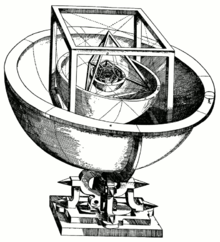 Today, it is known that the opposite is true: the earth goes around the sun. The Aristotelian and Ptolemaic ideas about the position of the stars and sun were disproved in 1609. The first person to present a detailed argument that the earth revolves around the sun was the Polish priest Nicholas Copernicus, in 1514. Nearly a century later, Galileo Galilei, an Italian scientist, and Johannes Kepler, a German scientist, studied how the moons of some planets moved in the sky, and used their observations to validate Copernicus's thinking. To fit the observations, Kepler proposed an elliptical orbit model instead of a circular one. In his 1687 book on gravity, Principia Mathematica, Isaac Newton used complex mathematics to further support Copernicus's idea. Newton's model also meant that stars, like the sun, were not fixed but, rather, faraway moving objects. Nevertheless, Newton believed that the universe was made up of an infinite number of stars which were more or less static. Many of his contemporaries, including German philosopher Heinrich Olbers, disagreed.Kepler's sun-centric elliptical orbit model of the solar system
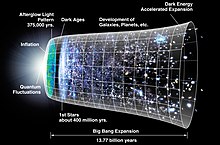 In this chapter, Hawking first describes how physicists and astronomers calculated the relative distance of stars from the Earth. In the 18th century, Sir William Herschel confirmed the positions and distances of many stars in the night sky. In 1924, Edwin Hubble discovered a method to measure the distance using brightness of the stars. The luminosity, brightness and distance are related by a simple mathematical formula. Using all these, he fairly calculated distances of nine different galaxies. We live in a spiral galaxy just like other galaxies containing vast amount of stars. The stars are very far away from us, so we only observe their one characteristic feature, their light. When this light is passed through a prism, it gives rise to a spectrum. Every star has its own spectrum and since each element has its own unique spectra, we can know a star's composition. We use thermal spectra of the stars to know their temperature. But in 1920, when scientists were examining spectra of different stars, they found that some of the characteristic lines of the star spectrum was shifted towards the red end of the spectrum. The implications of this phenomenon was given by the Doppler effect, and it was clear that some stars were moving away from us. So, it was assumed that since some stars are red shifted, some stars would also be blue shifted. But when found, none of them were blue shifted. In fact, Hubble found that the amount of redshift is directly proportional to relative distance. So, it was clear that Universe is expanding. Despite this the concept of a static universe persisted until the 20th century; Einstein was so sure of a static universe that he developed 'Cosmological Constant' and introduced 'anti gravity' forces to persist to the earlier claim. Moreover, many astronomers also tried to avoid the face value of General Relativity and stuck with their static universe except one Russian physicist Alexander Friedmann. He made two very simple assumptions: the universe is identical in every direction i.e. Homogenity and that this would be true wherever we look from i.e. Isotropy. His results showed that the Universe is non-static. His assumptions were later proved when 2 physicists at Bell's laboratory, Arno Penzias and Robert Wilson found extra microwave radiation noise not only from the one particular part of the sky but from everywhere and by nearly the same amount. Then, Friedmann's first assumption was proved as true. At the same time nearly, Robert H. Dicke and Jim Peebles were also working on the microwave radiation. They argued that they should be able to see the glow of the early universe as microwave radiations. But, Wilson and Penzias already did this, so they were awarded with Noble Prize in 1978. In addition, our place in the Universe is no exceptional, so we should see the universe as the same from any part of space, which proved Friedmann's second assumption. His work, though remained largely unknown until similar models were made by Howard Robertson and Arthur Walker.The Big Bang and evolution of the Universe is shown here. The picture shows the Universe expanding over time.
 How light behaves is also talked more about in this chapter. Some theories say that light acts like particles even though it really is made of waves; one theory that says this is Planck's quantum hypothesis. A different theory also says that light waves also act like particles; a theory that says this is Heisenberg's uncertainty principle.Here is a picture of a light wave.
 Light waves have crests and troughs. The highest point of a wave is the crest, and the lowest part of the wave is a trough. Sometimes more than one of these waves can interfere with each other - the crests and the troughs line up. This is called light interference. When light waves interfere with each other, this can make many colors. An example of this is the colors in soap bubbles.Light interference causes many colors to appear.
 All particles (for example, the quarks) have something called spin. The spin of a particle shows us what a particle looks like from different directions. For example, a particle of spin 0 looks the same from every direction. A particle of spin 1 looks different in every direction, unless the particle is spun completely around (360 degrees). Hawking's example of a particle of spin 1 is an arrow. A particle of spin two needs to be turned around halfway (or 180 degrees) to look the same. The example given in the book is of a double-headed arrow. There are two groups of particles in the universe: particles with a spin of 1/2, and particles with a spin of 0, 1, or 2. All of these particles follow Pauli's exclusion principle. Pauli's exclusion principle says that particles cannot be in the same place or have the same speed. If Pauli's exclusion principle did not exist, then everything in the universe would look the same, like a roughly uniform and dense "soup".A particle of spin 1 needs to be turned around all the way to look the same again, like this arrow.
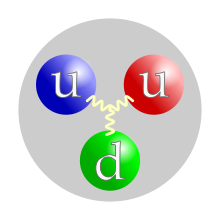 Particles with a spin of 0, 1, or 2 move force from one particle to another. Some examples of these particles are virtual gravitons and virtual photons. Virtual gravitons have a spin of 2 and they represent the force of gravity. This means that when gravity affects two things, gravitons move to and from the two things. Virtual photons have a spin of 1 and represent electromagnetic forces (or the force that holds atoms together).This is a proton. It is made up of three quarks. All the quarks are different colors because of confinement.
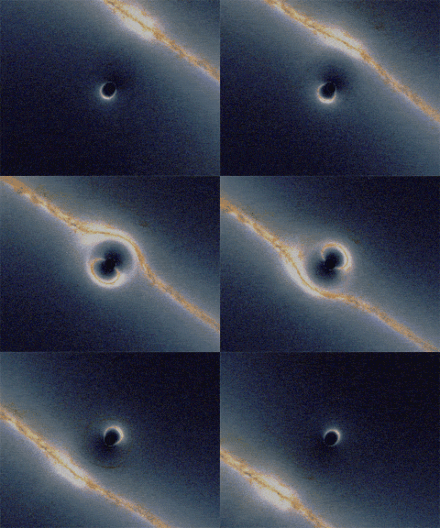 Black holes are talked about in this chapter. Black holes are stars that have collapsed into one very small point. This small point is called a singularity. Black holes suck things into their center because they have very strong gravity. Some of the things it can suck in are light and stars. Only very large stars, called super-giants, are big enough to become a black hole. The star must be one and a half times the mass of the sun or larger to turn into a black hole. This number is called the Chandrasekhar limit. If the mass of a star is less than the Chandrasekhar limit, it will not turn into a black hole; instead, it will turn into a different, smaller type of star. The boundary of the black hole is called the event horizon. If something is in the event horizon, it will never get out of the black hole.A picture of a black hole and how it changes light around it.
 How the universe started and how it might end is discussed in this chapter.The Big Bang and the evolution of the universe
 Physicists have come up with partial theories to describe a limited range of things, but a complete, unified and consistent theory which can take into account all of these partial theories remain unknown. Hawking is cautiously optimistic that such a unified theory of the universe may be found soon. Such a theory must combine the classical theory of gravity with the uncertainty principle found in quantum mechanics. Attempts to do that have led to the occurrence of absurd infinitely massed particles or an infinitely small universe. In 1976, the theory of "supergravity" was suggested as a solution. But the calculations to verify the theory was deemed time-consuming and thus abandoned.The fundamental objects of string theory are open and closed strings.


