
Wavefunctions of the
electron in a hydrogen atom at different energy levels. Quantum mechanics cannot predict the exact location of a particle in space, only the probability of finding it at different locations.
[1] The brighter areas represent a higher probability of finding the electron.
| Part of a series on |
| Quantum mechanics |
|---|

|
|
|
|
|
|
|
|
|
|
|
|
|
|
|
|
|
|
|
|
|
|
|
History[edit]
| Modern physics |
|---|

|
|
|
|
|
|
|
|
|
|
|
In 1838,
Michael Faraday discovered
cathode rays. These studies were followed by the 1859 statement of the
black-body radiationproblem by
Gustav Kirchhoff, the 1877 suggestion by
Ludwig Boltzmann that the energy states of a physical system can be discrete, and the 1900 quantum hypothesis of
Max Planck.
[8] Planck's hypothesis that energy is radiated and absorbed in discrete "quanta" (or energy packets) precisely matched the observed patterns of black-body radiation.
In 1896,
Wilhelm Wien empirically determined a distribution law of black-body radiation,
[9] known as
Wien's law in his honor. Ludwig Boltzmann independently arrived at this result by considerations of
Maxwell's equations. However, it was valid only at high frequencies and underestimated the radiance at low frequencies. Later, Planck corrected this model using Boltzmann's statistical interpretation of thermodynamics and proposed what is now called
Planck's law, which led to the development of quantum mechanics.
Among the first to study quantum phenomena in nature were
Arthur Compton,
C. V. Raman, and
Pieter Zeeman, each of whom has a quantum effect named after him.
Robert Andrews Millikan studied the
photoelectric effect experimentally, and Albert Einstein developed a theory for it. At the same time,
Ernest Rutherford experimentally discovered the nuclear model of the atom, for which
Niels Bohr developed his theory of the atomic structure, which was later confirmed by the experiments of
Henry Moseley. In 1913,
Peter Debyeextended Niels Bohr's theory of atomic structure, introducing
elliptical orbits, a concept also introduced by
Arnold Sommerfeld.
[11] This phase is known as
old quantum theory.
According to Planck, each energy element (
E)
is proportional to its
frequency (
ν):
 ,
,

Max Planck is considered the father of the quantum theory.
Planck cautiously insisted that this was simply an aspect of the processes of absorption and emission of radiation and had nothing to do with the
physical reality of the radiation itself.
[12] In fact, he considered his quantum hypothesis a mathematical trick to get the right answer rather than a sizable discovery.
[13] However, in 1905
Albert Einstein interpreted Planck's quantum hypothesis
realistically and used it to explain the
photoelectric effect, in which shining light on certain materials can eject electrons from the material. He won the 1921 Nobel Prize in Physics for this work.
Einstein further developed this idea to show that an
electromagnetic wave such as light could also be described as a particle (later called the
photon), with a discrete quantum of energy that was dependent on its frequency.
[14]
The foundations of quantum mechanics were established during the first half of the 20th century by
Max Planck,
Niels Bohr,
Werner Heisenberg,
Louis de Broglie,
Arthur Compton,
Albert Einstein,
Erwin Schrödinger,
Max Born,
John von Neumann,
Paul Dirac,
Enrico Fermi,
Wolfgang Pauli,
Max von Laue,
Freeman Dyson,
David Hilbert,
Wilhelm Wien,
Satyendra Nath Bose,
Arnold Sommerfeld, and
others. The
Copenhagen interpretation of
Niels Bohr became widely accepted.
In the mid-1920s, developments in quantum mechanics led to its becoming the standard formulation for atomic physics. In the summer of 1925, Bohr and Heisenberg published results that closed the old quantum theory. Out of deference to their particle-like behavior in certain processes and measurements, light quanta came to be called
photons (1926). In 1926
Erwin Schrödinger suggested a partial differential equation for the wave functions of particles like electrons. And when effectively restricted to a finite region, this equation allowed only certain modes, corresponding to discrete quantum states – whose properties turned out to be exactly the same as implied by matrix mechanics.
[15] From Einstein's simple postulation was born a flurry of debating, theorizing, and testing. Thus, the entire field of
quantum physics emerged, leading to its wider acceptance at the Fifth
Solvay Conference in 1927.
[citation needed]
By 1930, quantum mechanics had been further unified and formalized by the work of
David Hilbert,
Paul Dirac and
John von Neumann[16] with greater emphasis on
measurement, the statistical nature of our knowledge of reality, and
philosophical speculation about the 'observer'. It has since permeated many disciplines, including quantum chemistry,
quantum electronics,
quantum optics, and
quantum information science. Its speculative modern developments include
string theory and
quantum gravity theories. It also provides a useful framework for many features of the modern
periodic table of elements, and describes the behaviors of
atoms during
chemical bonding and the flow of
electrons in computer
semiconductors, and therefore plays a crucial role in many modern technologies.
[citation needed]
The word
quantum derives from the
Latin, meaning "how great" or "how much".
[19] In quantum mechanics, it refers to a discrete unit assigned to certain
physical quantities such as the
energy of an
atom at rest (see Figure 1). The discovery that particles are discrete packets of energy with wave-like properties led to the branch of physics dealing with atomic and subatomic systems which is today called quantum mechanics. It underlies the
mathematical framework of many fields of
physics and
chemistry, including
condensed matter physics,
solid-state physics,
atomic physics,
molecular physics,
computational physics,
computational chemistry, quantum chemistry,
particle physics,
nuclear chemistry, and
nuclear physics.
[20][better source needed] Some fundamental aspects of the theory are still actively studied.
[21]
Quantum mechanics is essential to understanding the behavior of systems at
atomic length scales and smaller. If the physical nature of an atom were solely described by
classical mechanics, electrons would not
orbit the nucleus, since orbiting electrons emit radiation (due to
circular motion) and would quickly collide with the nucleus due to this loss of energy. This framework was unable to explain the stability of atoms. Instead, electrons remain in an uncertain, non-deterministic,
smeared,
probabilistic wave–particle
orbital about the nucleus, defying the traditional assumptions of classical mechanics and
electromagnetism.
[22]
Quantum mechanics was initially developed to provide a better explanation and description of the atom, especially the differences in the
spectra of light emitted by different
isotopesof the same
chemical element, as well as subatomic particles. In short, the quantum-mechanical atomic model has succeeded spectacularly in the realm where classical mechanics and electromagnetism falter.
Broadly speaking, quantum mechanics incorporates four classes of phenomena for which classical physics cannot account:
Mathematical formulations[edit]
In the mathematically rigorous formulation of quantum mechanics developed by
Paul Dirac,
[25] David Hilbert,
[26] John von Neumann,
[27] and
Hermann Weyl,
[28] the possible states of a quantum mechanical system are symbolized
[29] as
unit vectors (called
state vectors). Formally, these reside in a
complex separable Hilbert space – variously called the
state spaceor the
associated Hilbert space of the system – that is well defined up to a complex number of norm 1 (the phase factor). In other words, the possible states are points in the
projective space of a Hilbert space, usually called the
complex projective space. The exact nature of this Hilbert space is dependent on the system – for example, the state space for position and momentum states is the space of
square-integrable functions, while the state space for the spin of a single proton is just the product of two complex planes. Each observable is represented by a maximally
Hermitian (precisely: by a
self-adjoint) linear
operator acting on the state space. Each
eigenstate of an observable corresponds to an
eigenvector of the operator, and the associated
eigenvalue corresponds to the value of the observable in that eigenstate. If the operator's spectrum is discrete, the observable can attain only those discrete eigenvalues.
In the formalism of quantum mechanics, the state of a system at a given time is described by a
complex wave function, also referred to as state vector in a complex
vector space.
[30]This abstract mathematical object allows for the calculation of
probabilities of outcomes of concrete experiments. For example, it allows one to compute the probability of finding an electron in a particular region around the nucleus at a particular time. Contrary to classical mechanics, one can never make simultaneous predictions of
conjugate variables, such as position and momentum, to arbitrary precision. For instance, electrons may be considered (to a certain probability) to be located somewhere within a given region of space, but with their exact positions unknown. Contours of constant probability density, often referred to as "clouds", may be drawn around the nucleus of an atom to conceptualize where the electron might be located with the most probability. Heisenberg's
uncertainty principle quantifies the inability to precisely locate the particle given its conjugate momentum.
[31]
According to one interpretation, as the result of a measurement, the wave function containing the probability information for a system
collapses from a given initial state to a particular instigate. The possible results of a measurement are the eigenvalues of the operator representing the observable – which explains the choice of
Hermitian operators, for which all the eigenvalues are real. The probability distribution of an observable in a given state can be found by computing the
spectral decomposition of the corresponding operator. Heisenberg's
uncertainty principle is represented by the statement that the operators corresponding to certain observable do not
commute.
The
probabilistic nature of quantum mechanics thus stems from the act of measurement. This is one of the most difficult aspects of quantum systems to understand. It was the central topic in the famous
Bohr–Einstein debates, in which the two scientists attempted to clarify these fundamental principles by way of
thought experiments. In the decades after the formulation of quantum mechanics, the question of what constitutes a "measurement" has been extensively studied. Newer
interpretations of quantum mechanics have been formulated that do away with the concept of "
wave function collapse" (see, for example, the
relative state interpretation). The basic idea is that when a quantum system interacts with a measuring apparatus, their respective wave functions become
entangled, so that the original quantum system ceases to exist as an independent entity. For details, see the article on
measurement in quantum mechanics.
[32]
Generally, quantum mechanics does not assign definite values. Instead, it makes a prediction using a
probability distribution; that is, it describes the probability of obtaining the possible outcomes from measuring an observable. Often these results are skewed by many causes, such as dense probability clouds. Probability clouds are approximate (but better than
the Bohr model) whereby electron location is given by a
probability function, the
wave function eigenvalue, such that the probability is the squared modulus of the
complex amplitude, or
quantum state nuclear attraction.
[33][34] Naturally, these probabilities will depend on the quantum state at the "instant" of the measurement. Hence, uncertainty is involved in the value. There are, however, certain states that are associated with a definite value of a particular observable. These are known as
eigenstates of the observable ("eigen" can be translated from German as meaning "inherent" or "characteristic").
[35]
In the everyday world, it is natural and intuitive to think of everything (every observable) as being in an eigenstate. Everything appears to have a definite position, a definite momentum, a definite energy, and a definite time of occurrence. However, quantum mechanics does not pinpoint the exact values of a particle's position and momentum (since they are
conjugate pairs) or its energy and time (since they too are conjugate pairs). Rather, it provides only a range of probabilities in which that particle might be given its momentum and momentum probability. Therefore, it is helpful to use different words to describe states having
uncertain values and states having
definite values (eigenstates).
Usually, a system will not be in an
eigenstate of the observable (particle) we are interested in. However, if one measures the observable, the wave function will instantaneously be an eigenstate (or "generalized" eigenstate) of that observable. This process is known as
wave function collapse, a controversial and much-debated process
[36] that involves expanding the system under study to include the measurement device. If one knows the corresponding wave function at the instant before the measurement, one will be able to compute the probability of the wave function collapsing into each of the possible eigenstates.
For example, the free particle in the previous example will usually have a wave function that is a
wave packet centered around some mean position
x0 (neither an eigenstate of position nor of momentum). When one measures the position of the particle, it is impossible to predict with certainty the result.
[32] It is probable, but not certain, that it will be near
x0, where the amplitude of the wave function is large. After the measurement is performed, having obtained some result
x, the wave function collapses into a position eigenstate centered at
x.
[37]
During a
measurement, on the other hand, the change of the initial wave function into another, later wave function is not deterministic, it is unpredictable (i.e.,
random). A time-evolution simulation can be seen here.
[39][40]
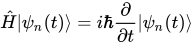
Wave functions change as time progresses. The
Schrödinger equation describes how wave functions change in time, playing a role similar to
Newton's second law in
classical mechanics. The Schrödinger equation, applied to the aforementioned example of the free particle, predicts that the center of a wave packet will move through space at a constant velocity (like a classical particle with no forces acting on it). However, the wave packet will also spread out as time progresses, which means that the position becomes more uncertain with time. This also has the effect of turning a position eigenstate (which can be thought of as an infinitely sharp wave packet) into a broadened wave packet that no longer represents a (definite, certain) position eigenstate.
[41]

Fig. 1:
Probability densities corresponding to the wave functions of an electron in a hydrogen atom possessing definite energy levels (increasing from the top of the image to the bottom:
n = 1, 2, 3, ...) and angular momenta (increasing across from left to right:
s,
p,
d, ...). Denser areas correspond to higher probability density in a position measurement. Such wave functions are directly comparable to
Chladni's figures of
acoustic modes of vibration in
classical physics, and are modes of oscillation as well, possessing a sharp
energy and, thus, a definite
frequency. The
angular momentum and energy are
quantized, and take
only discrete values like those shown (as is the case for
resonant frequencies in acoustics)
Some wave functions produce probability distributions that are constant, or independent of time – such as when in a
stationary state of constant energy, time vanishes in the absolute square of the wave function. Many systems that are treated dynamically in classical mechanics are described by such "static" wave functions. For example, a single
electron in an unexcited
atom is pictured classically as a particle moving in a circular trajectory around the
atomic nucleus, whereas in quantum mechanics it is described by a static,
spherically symmetric wave function surrounding the nucleus (
Fig. 1) (note, however, that only the lowest angular momentum states, labeled
s, are spherically symmetric).
[42]
There exist several techniques for generating approximate solutions, however. In the important method known as
perturbation theory, one uses the analytic result for a simple quantum mechanical model to generate a result for a more complicated model that is related to the simpler model by (for one example) the addition of a weak
potential energy. Another method is the "semi-classical equation of motion" approach, which applies to systems for which quantum mechanics produces only weak (small) deviations from classical behavior. These deviations can then be computed based on the classical motion. This approach is particularly important in the field of
quantum chaos.
Mathematically equivalent formulations of quantum mechanics[edit]
Especially since
Werner Heisenberg was awarded the
Nobel Prize in Physics in 1932 for the creation of quantum mechanics, the role of
Max Born in the development of QM was overlooked until the 1954 Nobel award. The role is noted in a 2005 biography of Born, which recounts his role in the matrix formulation of quantum mechanics, and the use of probability amplitudes. Heisenberg himself acknowledges having learned matrices from Born, as published in a 1940
festschrifthonoring
Max Planck.
[44] In the matrix formulation, the instantaneous state of a quantum system encodes the probabilities of its measurable properties, or "
observables". Examples of observables include
energy,
position,
momentum, and
angular momentum. Observables can be either
continuous (e.g., the position of a particle) or
discrete (e.g., the energy of an electron bound to a hydrogen atom).
[45] An alternative formulation of quantum mechanics is
Feynman's
path integral formulation, in which a quantum-mechanical amplitude is considered as a sum over all possible classical and non-classical paths between the initial and final states. This is the quantum-mechanical counterpart of the
action principle in classical mechanics.
Interactions with other scientific theories[edit]
The rules of quantum mechanics are fundamental. They assert that the state space of a system is a
Hilbert space (crucially, that the space has an
inner product) and that observables of that system are
Hermitian operators acting on vectors in that space – although they do not tell us which Hilbert space or which operators. These can be chosen appropriately in order to obtain a quantitative description of a quantum system. An important guide for making these choices is the
correspondence principle, which states that the predictions of quantum mechanics reduce to those of classical mechanics when a system moves to higher energies or, equivalently, larger quantum numbers, i.e. whereas a single particle exhibits a degree of randomness, in systems incorporating millions of particles averaging takes over and, at the high energy limit, the statistical probability of random behaviour approaches zero. In other words, classical mechanics is simply a quantum mechanics of large systems. This "high energy" limit is known as the
classical or
correspondence limit. One can even start from an established classical model of a particular system, then attempt to guess the underlying quantum model that would give rise to the classical model in the correspondence limit.
Early attempts to merge quantum mechanics with
special relativity involved the replacement of the Schrödinger equation with a covariant equation such as the
Klein–Gordon equation or the
Dirac equation. While these theories were successful in explaining many experimental results, they had certain unsatisfactory qualities stemming from their neglect of the relativistic creation and annihilation of particles. A fully relativistic quantum theory required the development of
quantum field theory, which applies quantization to a field (rather than a fixed set of particles). The first complete quantum field theory,
quantum electrodynamics, provides a fully quantum description of the
electromagnetic interaction. The full apparatus of quantum field theory is often unnecessary for describing electrodynamic systems. A simpler approach, one that has been employed since the inception of quantum mechanics, is to treat
charged particles as quantum mechanical objects being acted on by a classical
electromagnetic field. For example, the elementary quantum model of the
hydrogen atom describes the
electric field of the hydrogen atom using a classical
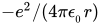 Coulomb potential
. This "semi-classical" approach fails if quantum fluctuations in the electromagnetic field play an important role, such as in the emission of
photons by
charged particles.
It has proven difficult to construct quantum models of
gravity, the remaining
fundamental force. Semi-classical approximations are workable, and have led to predictions such as
Hawking radiation. However, the formulation of a complete theory of
quantum gravity is hindered by apparent incompatibilities between
general relativity (the most accurate theory of gravity currently known) and some of the fundamental assumptions of quantum theory. The resolution of these incompatibilities is an area of active research, and theories such as
string theory are among the possible candidates for a future theory of quantum gravity.
Classical mechanics has also been extended into the
complex domain, with complex classical mechanics exhibiting behaviors similar to quantum mechanics.
[47]
Quantum mechanics and classical physics[edit]
Predictions of quantum mechanics have been verified experimentally to an extremely high degree of
accuracy.
[48] According to the
correspondence principle between classical and quantum mechanics, all objects obey the laws of quantum mechanics, and classical mechanics is just an approximation for large systems of objects (or a statistical quantum mechanics of a large collection of particles).
[49] The laws of classical mechanics thus follow from the laws of quantum mechanics as a statistical average at the limit of large systems or large
quantum numbers.
[50] However,
chaotic systems do not have good quantum numbers, and
quantum chaos studies the relationship between classical and quantum descriptions in these systems.
Quantum coherence is an essential difference between classical and quantum theories as illustrated by the
Einstein–Podolsky–Rosen (EPR) paradox – an attack on a certain philosophical interpretation of quantum mechanics by an appeal to
local realism.
[51] Quantum interference involves adding together
probability amplitudes, whereas classical "waves" infer that there is an adding together of
intensities. For microscopic bodies, the extension of the system is much smaller than the
coherence length, which gives rise to long-range entanglement and other nonlocal phenomena characteristic of quantum systems.
[52] Quantum coherence is not typically evident at macroscopic scales, though an exception to this rule may occur at extremely low temperatures (i.e. approaching
absolute zero) at which quantum behavior may manifest itself macroscopically.
[53] This is in accordance with the following observations:
- Many macroscopic properties of a classical system are a direct consequence of the quantum behavior of its parts. For example, the stability of bulk matter (consisting of atoms and molecules which would quickly collapse under electric forces alone), the rigidity of solids, and the mechanical, thermal, chemical, optical and magnetic properties of matter are all results of the interaction of electric charges under the rules of quantum mechanics.[54]
- While the seemingly "exotic" behavior of matter posited by quantum mechanics and relativity theory become more apparent when dealing with particles of extremely small size or velocities approaching the speed of light, the laws of classical, often considered "Newtonian", physics remain accurate in predicting the behavior of the vast majority of "large" objects (on the order of the size of large molecules or bigger) at velocities much smaller than the velocity of light.[55]
Copenhagen interpretation of quantum versus classical kinematics[edit]
A big difference between classical and quantum mechanics is that they use very different kinematic descriptions.
[56]
In
Niels Bohr's mature view, quantum mechanical phenomena are required to be experiments, with complete descriptions of all the devices for the system, preparative, intermediary, and finally measuring. The descriptions are in macroscopic terms, expressed in ordinary language, supplemented with the concepts of classical mechanics.
[57][58][59][60] The initial condition and the final condition of the system are respectively described by values in a configuration space, for example a position space, or some equivalent space such as a momentum space. Quantum mechanics does not admit a completely precise description, in terms of both position and momentum, of an initial condition or "state" (in the classical sense of the word) that would support a precisely deterministic and causal prediction of a final condition.
[61][62] In this sense, advocated by Bohr in his mature writings, a quantum phenomenon is a process, a passage from initial to final condition, not an instantaneous "state" in the classical sense of that word.
[63][64] Thus there are two kinds of processes in quantum mechanics: stationary and transitional. For a stationary process, the initial and final condition are the same. For a transition, they are different. Obviously by definition, if only the initial condition is given, the process is not determined.
[61] Given its initial condition, prediction of its final condition is possible, causally but only probabilistically, because the Schrödinger equation is deterministic for wave function evolution, but the wave function describes the system only probabilistically.
[65][66]
For many experiments, it is possible to think of the initial and final conditions of the system as being a particle. In some cases it appears that there are potentially several spatially distinct pathways or trajectories by which a particle might pass from initial to final condition. It is an important feature of the quantum kinematic description that it does not permit a unique definite statement of which of those pathways is actually followed. Only the initial and final conditions are definite, and, as stated in the foregoing paragraph, they are defined only as precisely as allowed by the configuration space description or its equivalent. In every case for which a quantum kinematic description is needed, there is always a compelling reason for this restriction of kinematic precision. An example of such a reason is that for a particle to be experimentally found in a definite position, it must be held motionless; for it to be experimentally found to have a definite momentum, it must have free motion; these two are logically incompatible.
[67][68]
Classical kinematics does not primarily demand experimental description of its phenomena. It allows completely precise description of an instantaneous state by a value in phase space, the Cartesian product of configuration and momentum spaces. This description simply assumes or imagines a state as a physically existing entity without concern about its experimental measurability. Such a description of an initial condition, together with Newton's laws of motion, allows a precise deterministic and causal prediction of a final condition, with a definite trajectory of passage.
Hamiltonian dynamics can be used for this. Classical kinematics also allows the description of a process analogous to the initial and final condition description used by quantum mechanics.
Lagrangian mechanics applies to this.
[69] For processes that need account to be taken of actions of a small number of
Planck constants, classical kinematics is not adequate; quantum mechanics is needed.
General relativity and quantum mechanics[edit]
Even with the defining postulates of both Einstein's theory of general relativity and quantum theory being indisputably supported by rigorous and repeated
empirical evidence, and while they do not directly contradict each other theoretically (at least with regard to their primary claims), they have proven extremely difficult to incorporate into one consistent, cohesive model.
[70]
Gravity is negligible in many areas of particle physics, so that unification between general relativity and quantum mechanics is not an urgent issue in those particular applications. However, the lack of a correct theory of
quantum gravity is an important issue in
physical cosmology and the search by physicists for an elegant "
Theory of Everything" (TOE). Consequently, resolving the inconsistencies between both theories has been a major goal of 20th- and 21st-century physics. Many prominent physicists, including
Stephen Hawking, have labored for many years in the attempt to discover a theory underlying
everything. This TOE would combine not only the different models of subatomic physics, but also derive the four
fundamental forces of nature – the
strong force,
electromagnetism, the
weak force, and
gravity – from a single force or phenomenon. While Stephen Hawking was initially a believer in the Theory of Everything, after considering
Gödel's Incompleteness Theorem, he has concluded that one is not obtainable, and has stated so publicly in his lecture "Gödel and the End of Physics" (2002).
[71]
Attempts at a unified field theory[edit]
The quest to unify the
fundamental forces through quantum mechanics is still ongoing.
Quantum electrodynamics (or "quantum electromagnetism"), which is currently (in the perturbative regime at least) the most accurately tested physical theory in competition with general relativity,
[72][73] has been successfully merged with the weak nuclear force into the
electroweak force and work is currently being done to merge the electroweak and strong force into the
electrostrong force. Current predictions state that at around 10
14 GeV the three aforementioned forces are fused into a single unified field.
[74] Beyond this "grand unification", it is speculated that it may be possible to merge gravity with the other three gauge symmetries, expected to occur at roughly 10
19 GeV. However – and while special relativity is parsimoniously incorporated into quantum electrodynamics – the expanded
general relativity, currently the best theory describing the gravitation force, has not been fully incorporated into quantum theory. One of those searching for a coherent TOE is
Edward Witten, a theoretical physicist who formulated the
M-theory, which is an attempt at describing the supersymmetrical based
string theory. M-theory posits that our apparent
4-dimensional spacetime is, in reality, actually an 11-dimensional spacetime containing 10 spatial dimensions and 1 time dimension, although 7 of the spatial dimensions are – at lower energies – completely "compactified" (or infinitely curved) and not readily amenable to measurement or probing.
Another popular theory is
Loop quantum gravity (LQG), a theory first proposed by
Carlo Rovelli that describes the quantum properties of gravity. It is also a theory of
quantum spaceand
quantum time, because in general relativity the geometry of spacetime is a manifestation of
gravity. LQG is an attempt to merge and adapt standard quantum mechanics and standard
general relativity. The main output of the theory is a physical picture of space where space is granular. The granularity is a direct consequence of the quantization. It has the same nature of the granularity of the photons in the quantum theory of electromagnetism or the discrete levels of the energy of the atoms. But here it is space itself which is discrete. More precisely, space can be viewed as an extremely fine fabric or network "woven" of finite loops. These networks of loops are called
spin networks. The evolution of a spin network over time is called a spin foam. The predicted size of this structure is the
Planck length, which is approximately 1.616×10
−35 m. According to theory, there is no meaning to length shorter than this (cf.
Planck scale energy). Therefore, LQG predicts that not just matter, but also space itself, has an atomic structure.
Philosophical implications[edit]
The
Copenhagen interpretation – due largely to Niels Bohr and Werner Heisenberg – remains most widely accepted amongst physicists, some 75 years after its enunciation. According to this interpretation, the probabilistic nature of quantum mechanics is not a
temporary feature which will eventually be replaced by a deterministic theory, but instead must be considered a
final renunciation of the classical idea of "causality." It is also believed therein that any well-defined application of the quantum mechanical formalism must always make reference to the experimental arrangement, due to the
conjugate nature of evidence obtained under different experimental situations.
Albert Einstein, himself one of the founders of quantum theory, did not accept some of the more philosophical or metaphysical interpretations of quantum mechanics, such as rejection of
determinism and of
causality. He is famously quoted as saying, in response to this aspect, "God does not play with dice".
[77] He rejected the concept that the state of a physical system depends on the experimental arrangement for its measurement. He held that a state of nature occurs in its own right, regardless of whether or how it might be observed. In that view, he is supported by the currently accepted definition of a quantum state, which remains invariant under arbitrary choice of configuration space for its representation, that is to say, manner of observation. He also held that underlying quantum mechanics there should be a theory that thoroughly and directly expresses the rule against
action at a distance; in other words, he insisted on the
principle of locality. He considered, but rejected on theoretical grounds, a particular proposal for hidden variables to obviate the indeterminism or acausality of quantum mechanical measurement. He considered that quantum mechanics was a currently valid but not a permanently definitive theory for quantum phenomena. He thought its future replacement would require profound conceptual advances, and would not come quickly or easily. The
Bohr-Einstein debates provide a vibrant critique of the Copenhagen Interpretation from an
epistemological point of view. In arguing for his views, he produced a series of objections, the most famous of which has become known as the
Einstein–Podolsky–Rosen paradox.
John Bell showed that this
EPR paradox led to
experimentally testable differences between quantum mechanics and theories that rely on added hidden variables.
Experiments have been performed confirming the accuracy of quantum mechanics, thereby demonstrating that quantum mechanics cannot be improved upon by addition of hidden variables.
[78] Alain Aspect's initial experiments in 1982, and many subsequent experiments since, have definitively verified quantum entanglement. By the early 1980s, experiments had shown that such inequalities were indeed violated in practice – so that there were in fact correlations of the kind suggested by quantum mechanics. At first these just seemed like isolated esoteric effects, but by the mid-1990s, they were being codified in the field of quantum information theory, and led to constructions with names like
quantum cryptography and
quantum teleportation.
[79]
Entanglement, as demonstrated in Bell-type experiments, does not, however, violate
causality, since no transfer of information happens. Quantum entanglement forms the basis of
quantum cryptography, which is proposed for use in high-security commercial applications in banking and government.
The
Everett many-worlds interpretation, formulated in 1956, holds that
all the possibilities described by quantum theory
simultaneously occur in a
multiverse composed of mostly independent parallel universes.
[80] This is not accomplished by introducing some "new axiom" to quantum mechanics, but on the contrary, by
removing the axiom of the collapse of the wave packet.
All of the possible consistent states of the measured system and the measuring apparatus (including the observer) are present in a
real physical – not just formally mathematical, as in other interpretations –
quantum superposition. Such a superposition of consistent state combinations of different systems is called an
entangled state. While the multiverse is deterministic, we perceive non-deterministic behavior governed by probabilities, because we can only observe the universe (i.e., the consistent state contribution to the aforementioned superposition) that we, as observers, inhabit. Everett's interpretation is perfectly consistent with
John Bell's experiments and makes them intuitively understandable. However, according to the theory of
quantum decoherence, these "parallel universes" will never be accessible to us. The inaccessibility can be understood as follows: once a measurement is done, the measured system becomes
entangled with
both the physicist who measured it
and a huge number of other particles, some of which are
photons flying away at the
speed of light towards the other end of the universe. In order to prove that the wave function did not collapse, one would have to bring
all these particles back and measure them again, together with the system that was originally measured. Not only is this completely impractical, but even if one
could theoretically do this, it would have to destroy any evidence that the original measurement took place (including the physicist's memory). In light of these
Bell tests, Cramer (1986) formulated his
transactional interpretation[81] which is unique in providing a physical explanation for the
Born rule.
[82] Relational quantum mechanics appeared in the late 1990s as the modern derivative of the
Copenhagen Interpretation.
Applications[edit]
Quantum mechanics is also critically important for understanding how individual atoms are joined by covalent bond to form
molecules. The application of quantum mechanics to
chemistry is known as quantum chemistry. Quantum mechanics can also provide quantitative insight into
ionic and
covalent bonding processes by explicitly showing which molecules are energetically favorable to which others and the magnitudes of the energies involved.
[84] Furthermore, most of the calculations performed in modern
computational chemistry rely on quantum mechanics.
In many aspects modern technology operates at a scale where quantum effects are significant.
Electronics[edit]
Many electronic devices operate under effect of
quantum tunneling. It even exists in the simple
light switch. The switch would not work if electrons could not quantum tunnel through the layer of oxidation on the metal contact surfaces.
Flash memory chips found in
USB drives use quantum tunneling to erase their memory cells. Some negative differential resistance devices also utilize quantum tunneling effect, such as
resonant tunneling diode. Unlike classical diodes, its current is carried by
resonant tunneling through two or more
potential barriers (see right figure). Its negative resistance behavior can only be understood with quantum mechanics: As the confined state moves close to
Fermi level, tunnel current increases. As it moves away, current decreases. Quantum mechanics is necessary to understanding and designing such electronic devices.
Cryptography[edit]
Researchers are currently seeking robust methods of directly manipulating quantum states. Efforts are being made to more fully develop
quantum cryptography, which will theoretically allow guaranteed secure transmission of information.
An inherent advantage yielded by quantum cryptography when compared to classical
cryptography is the detection of passive
eavesdropping. This is a natural result of the behavior of quantum bits; due to the
observer effect, if a bit in a superposition state were to be observed, the superposition state would collapse into an
eigenstate. Because the intended recipient was expecting to receive the bit in a superposition state, the intended recipient would know there was an attack, because the bit's state would no longer be in a superposition.
[85]
Quantum computing[edit]
Another goal is the development of
quantum computers, which are expected to perform certain computational tasks exponentially faster than classical
computers. Instead of using classical bits, quantum computers use
qubits, which can be in
superpositions of states. Quantum programmers are able to manipulate the superposition of qubits in order to solve problems that classical computing cannot do effectively, such as searching unsorted databases or
integer factorization.
IBM claims that the advent of quantum computing may progress the fields of medicine, logistics, financial services,
artificial intelligence and cloud security.
[86]
Another active research topic is
quantum teleportation, which deals with techniques to transmit quantum information over arbitrary distances.
Macroscale quantum effects[edit]
Quantum theory[edit]
Quantum theory also provides accurate descriptions for many previously unexplained phenomena, such as
black-body radiation and the stability of the
orbitals of electrons in atoms. It has also given insight into the workings of many different
biological systems, including
smell receptors and
protein structures.
[88] Recent work on
photosynthesis has provided evidence that quantum correlations play an essential role in this fundamental process of plants and many other organisms.
[89] Even so,
classical physics can often provide good approximations to results otherwise obtained by quantum physics, typically in circumstances with large numbers of particles or large
quantum numbers. Since classical formulas are much simpler and easier to compute than quantum formulas, classical approximations are used and preferred when the system is large enough to render the effects of quantum mechanics insignificant.
Examples[edit]
Free particle[edit]
For example, consider a
free particle. In quantum mechanics, a free matter is described by a wave function. The particle properties of the matter become apparent when we measure its position and velocity. The wave properties of the matter become apparent when we measure its wave properties like interference. The
wave–particle duality feature is incorporated in the relations of coordinates and operators in the formulation of quantum mechanics. Since the matter is free (not subject to any interactions), its quantum state can be represented as a
wave of arbitrary shape and extending over space as a
wave function. The position and momentum of the particle are
observables. The
Uncertainty Principle states that both the position and the momentum cannot simultaneously be measured with complete precision. However, one
can measure the position (alone) of a moving free particle, creating an eigenstate of position with a wave function that is very large (a
Dirac delta) at a particular position
x, and zero everywhere else. If one performs a position measurement on such a wave function, the resultant
x will be obtained with 100% probability (i.e., with full certainty, or complete precision). This is called an eigenstate of position – or, stated in mathematical terms, a
generalized position eigenstate (eigendistribution). If the particle is in an eigenstate of position, then its momentum is completely unknown. On the other hand, if the particle is in an eigenstate of momentum, then its position is completely unknown.
[90] In an eigenstate of momentum having a
plane wave form, it can be shown that the
wavelength is equal to
h/p, where
h is
Planck's constant and
p is the momentum of the
eigenstate.
[91]
Particle in a box[edit]

1-dimensional potential energy box (or infinite potential well)
The particle in a one-dimensional potential energy box is the most mathematically simple example where restraints lead to the quantization of energy levels. The box is defined as having zero potential energy everywhere
inside a certain region, and therefore infinite potential energy everywhere
outside that region. For the one-dimensional case in the

direction, the time-independent Schrödinger equation may be written
[92]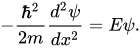
With the differential operator defined by
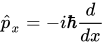

with state

in this case having energy

coincident with the kinetic energy of the particle.
The general solutions of the Schrödinger equation for the particle in a box are


The infinite potential walls of the box determine the values of C, D, and k at x = 0 and x = L where ψ must be zero. Thus, at x = 0,

and D = 0. At x = L,

in which
C cannot be zero as this would conflict with the Born interpretation. Therefore, since
sin(kL) = 0,
kL must be an integer multiple of
π,

The quantization of energy levels follows from this constraint on k, since
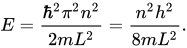
- The ground state energy of the particles is E1 for n=1.
- Energy of particle in the nth state is En =n2E1, n=2,3,4,.....
- Particle in a box with boundary condition V(x)=0 -a/2<x<+a/2

A particle in a box with a little change in the boundary condition.
In this condition the general solution will be same, there will a little change to the final result, since the boundary conditions are changed- At x=0, the wave function is not actually zero at all value of n.
- Clearly, from the wave function variation graph we have,
- At n=1,3,4,...... the wave function follows a cosine curve with x=0 as origin
- At n=2,4,6,...... the wave function follows a sine curve with x=0 as origin
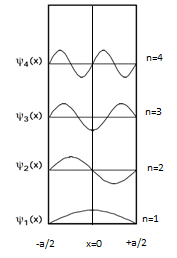
Wave Function Variation with x and n.
- From this observation we can conclude that the wave function is alternatively sine and cosine.
- So in this case the resultant wave equation is
- ψn(x) = Acos(knx) n=1,3,5,.............
- = Bsin(knx) n=2,4,6,.............
Finite potential well[edit]
A finite potential well is the generalization of the infinite potential well problem to potential wells having finite depth.
The finite potential well problem is mathematically more complicated than the infinite particle-in-a-box problem as the wave function is not pinned to zero at the walls of the well. Instead, the wave function must satisfy more complicated mathematical boundary conditions as it is nonzero in regions outside the well.
Rectangular potential barrier[edit]
Harmonic oscillator[edit]
As in the classical case, the potential for the quantum harmonic oscillator is given by
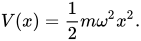
This problem can either be treated by directly solving the Schrödinger equation, which is not trivial, or by using the more elegant "ladder method" first proposed by Paul Dirac. The
eigenstates are given by



and the corresponding energy levels are
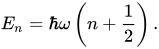
This is another example illustrating the quantification of energy for bound states.
Step potential[edit]

Scattering at a finite potential step of height
V0, shown in green. The amplitudes and direction of left- and right-moving waves are indicated. Yellow is the incident wave, blue are reflected and transmitted waves, red does not occur.
E >
V0 for this figure.
The potential in this case is given by:
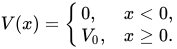
The solutions are superpositions of left- and right-moving waves:

and
 ,
,
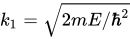
and
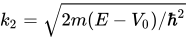 .
.
Each term of the solution can be interpreted as an incident, reflected, or transmitted component of the wave, allowing the calculation of transmission and reflection coefficients. Notably, in contrast to classical mechanics, incident particles with energies greater than the potential step are partially reflected.


.jpg)


